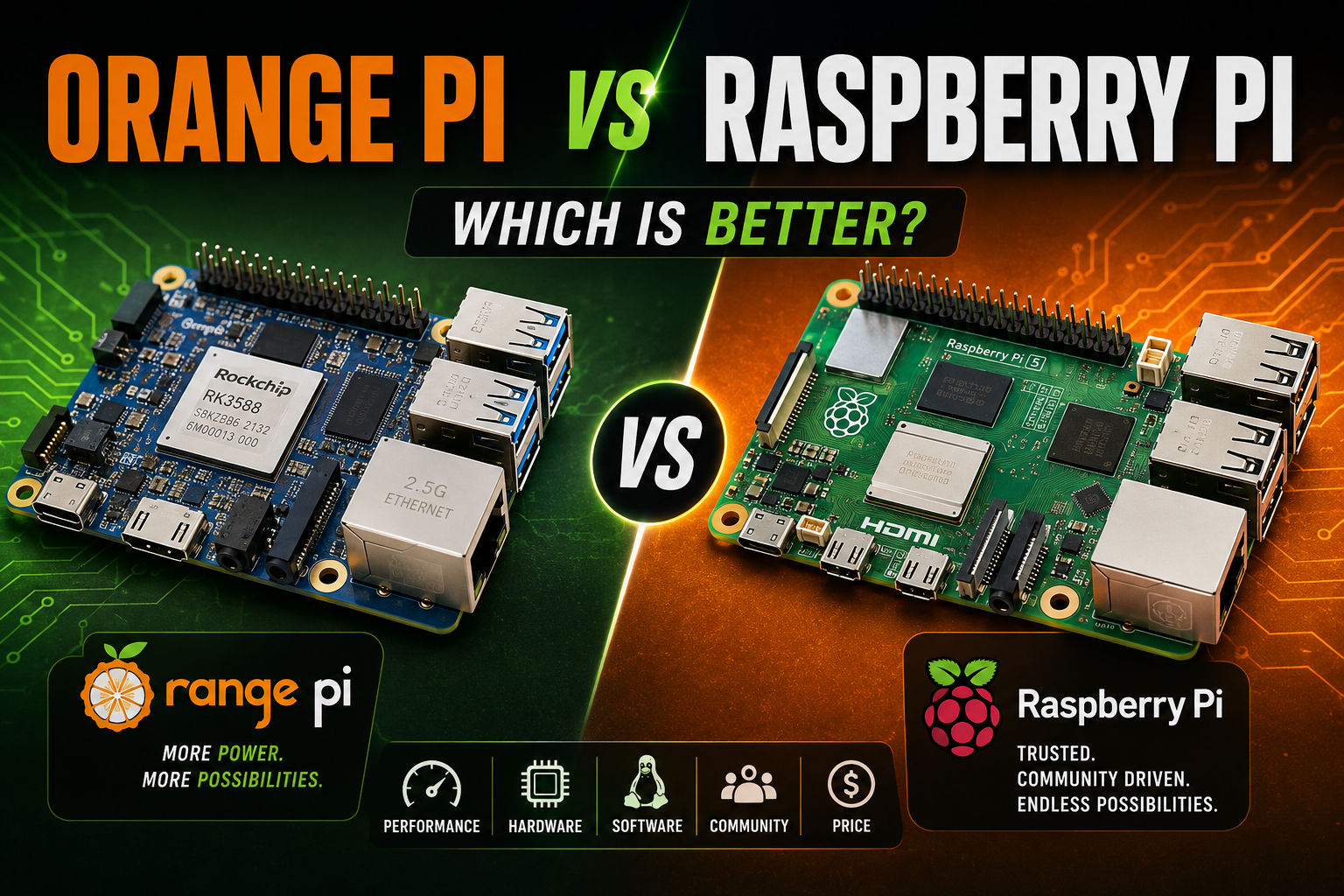
If you’re looking for a single board computer (SBC), two names are likely to top your list: Orange Pi and Raspberry Pi. Both platforms offer compact, low-power computers capable of running Linux, Android, and a wide variety of applications, from home servers to robotics and AI projects.
But which one is the better choice?
The answer depends on your priorities. Raspberry Pi remains the leader in software support and community resources, while Orange Pi often delivers more powerful hardware at a lower price. In this guide, we’ll compare performance, operating systems, connectivity, expandability, pricing, and real-world use cases to help you choose the right board.
Quick Comparison
| Feature | Raspberry Pi 5 | Orange Pi 5 Ultra |
|---|---|---|
| CPU | Broadcom BCM2712 | Rockchip RK3588 |
| CPU Cores | 4 | 8 |
| RAM | Up to 16GB | Up to 16GB |
| GPU | VideoCore VII | Mali-G610 MP4 |
| NVMe Support | Yes (PCIe adapter) | Native M.2 NVMe |
| Ethernet | Gigabit | 2.5 Gigabit |
| Wi-Fi | Wi-Fi 5 | Wi-Fi 6 |
| AI Performance | Good | Excellent |
| Community | ⭐⭐⭐⭐⭐ | ⭐⭐⭐ |
| Linux Support | Excellent | Very Good |
| Beginner Friendly | ⭐⭐⭐⭐⭐ | ⭐⭐⭐⭐ |
| Price-to-Performance | ⭐⭐⭐⭐ | ⭐⭐⭐⭐⭐ |
Winner: It depends on your priorities. Raspberry Pi excels in ecosystem and ease of use, while Orange Pi offers stronger hardware for demanding workloads.
Raspberry Pi Overview
The Raspberry Pi has become the most recognized SBC in the world thanks to its exceptional documentation, stable software ecosystem, and massive community.
Advantages
- Huge community support
- Excellent documentation
- Official Raspberry Pi OS
- Extensive accessory ecosystem
- Strong compatibility with HATs and GPIO projects
- Beginner-friendly
Disadvantages
- Often more expensive than similarly powered competitors
- Accessories increase the total cost
- CPU performance trails newer RK3588-based boards
Orange Pi Overview
Orange Pi has gained popularity by offering high-performance ARM hardware at competitive prices.
Boards like the Orange Pi 5 Ultra include:
- Rockchip RK3588 processor
- Up to 16GB RAM
- Native NVMe support
- 2.5Gb Ethernet
- Wi-Fi 6
- Powerful Mali GPU
These features make Orange Pi attractive for developers, AI workloads, and home servers.
CPU Performance
For raw processing power, Orange Pi has a clear advantage.
Raspberry Pi 5
- Quad-core Cortex-A76
- Excellent everyday performance
- Great efficiency
- Ideal for education and general-purpose projects
Orange Pi 5 Ultra
- Octa-core RK3588
- Higher multi-core performance
- Better GPU
- Stronger multimedia capabilities
- Superior AI acceleration
Winner: 🏆 Orange Pi
Operating System Support
Raspberry Pi
Supports:
- Raspberry Pi OS
- Ubuntu
- Debian
- Fedora
- Kali Linux
- LibreELEC
- Home Assistant OS
Software support is mature and well documented.
Orange Pi
Supports:
- Ubuntu
- Debian
- Armbian
- Android
- OpenHarmony
Linux support has improved significantly, though some images and features may require additional configuration.
Winner: 🏆 Raspberry Pi
Community and Documentation
This is one of Raspberry Pi’s biggest strengths.
You’ll find:
- Thousands of tutorials
- Active forums
- Countless YouTube videos
- Books and online courses
- Large open-source community
Orange Pi’s community is growing but remains smaller.
Winner: 🏆 Raspberry Pi
Connectivity
| Feature | Raspberry Pi 5 | Orange Pi 5 Ultra |
|---|---|---|
| USB 3.0 | Yes | Yes |
| Gigabit Ethernet | Yes | 2.5Gb Ethernet |
| Wi-Fi | Wi-Fi 5 | Wi-Fi 6 |
| Bluetooth | 5.x | 5.x |
| NVMe | Adapter required | Native support |
Winner: 🏆 Orange Pi
Home Server Performance
If you’re building a NAS or Docker server, Orange Pi has several advantages:
- Native NVMe support
- Faster networking
- Better multi-core performance
- More capable for virtualization and containers
Raspberry Pi remains a good choice for lighter services such as:
- Pi-hole
- Home Assistant
- WireGuard
- Small file servers
Winner: 🏆 Orange Pi
AI and Edge Computing
Orange Pi’s RK3588 platform includes hardware better suited for AI and machine learning workloads.
It performs well with:
- Object detection
- Computer vision
- TensorFlow Lite
- Edge AI applications
Raspberry Pi can run AI projects but generally benefits from external accelerators for more demanding tasks.
Winner: 🏆 Orange Pi
GPIO and Electronics Projects
Both platforms offer GPIO headers suitable for electronics and embedded projects.
Raspberry Pi has an advantage because:
- More tutorials
- Better HAT compatibility
- Larger accessory ecosystem
Winner: 🏆 Raspberry Pi
Price
Orange Pi typically offers more hardware for the money.
You often get:
- More CPU cores
- Faster networking
- Better GPU
- Native NVMe support
for a similar or lower price.
Winner: 🏆 Orange Pi
Which Board Should You Buy?
Choose Raspberry Pi if you:
- Are new to SBCs
- Want the easiest setup
- Need the largest community
- Plan to follow online tutorials
- Use educational projects
- Need broad accessory compatibility
Choose Orange Pi if you:
- Want maximum performance
- Need NVMe storage
- Plan to run Docker containers
- Build a home server
- Work with AI or edge computing
- Want the best hardware value
Frequently Asked Questions
Is Orange Pi faster than Raspberry Pi?
Yes. High-end Orange Pi boards based on the RK3588 generally offer stronger multi-core CPU performance, a more capable GPU, and additional connectivity such as native NVMe and 2.5Gb Ethernet.
Is Raspberry Pi easier to use?
Yes. Raspberry Pi has the largest ecosystem, excellent documentation, and outstanding community support, making it the easiest choice for beginners.
Can Orange Pi run Raspberry Pi OS?
No. Raspberry Pi OS is designed specifically for Raspberry Pi hardware. Orange Pi boards are better served by distributions such as Ubuntu, Debian, or Armbian that support their hardware.
Which is better for Home Assistant?
Both platforms work well.
- Raspberry Pi is easier for beginners.
- Orange Pi provides more headroom if you plan to run Home Assistant alongside Docker containers, media servers, or other self-hosted services.
Final Verdict
There is no universal winner because the best choice depends on your goals.
If you value ease of use, stability, documentation, and a massive ecosystem, the Raspberry Pi 5 remains the best all-around option. It’s ideal for education, DIY electronics, and users who want a straightforward experience.
If your priority is performance, networking, storage, and value for money, the Orange Pi 5 Ultra is the stronger choice. Its RK3588 processor, native NVMe support, and faster connectivity make it an excellent platform for home servers, AI projects, multimedia applications, and advanced Linux workloads.
For many enthusiasts, the ideal setup is to use a Raspberry Pi for learning and hardware projects while choosing an Orange Pi for demanding server or performance-focused applications.
Suggested Internal Links
- Best Raspberry Pi Alternatives
- Best Single Board Computers
- Best Single Board Computers for Home Servers
- How to Choose the Right Single Board Computer
- How to Install Linux on a Single Board Computer
- Best Operating Systems for Single Board Computers
- ARM vs x86 Single Board Computers
- Best SBC for Home Assistant
- What Can You Do With a Single Board Computer?