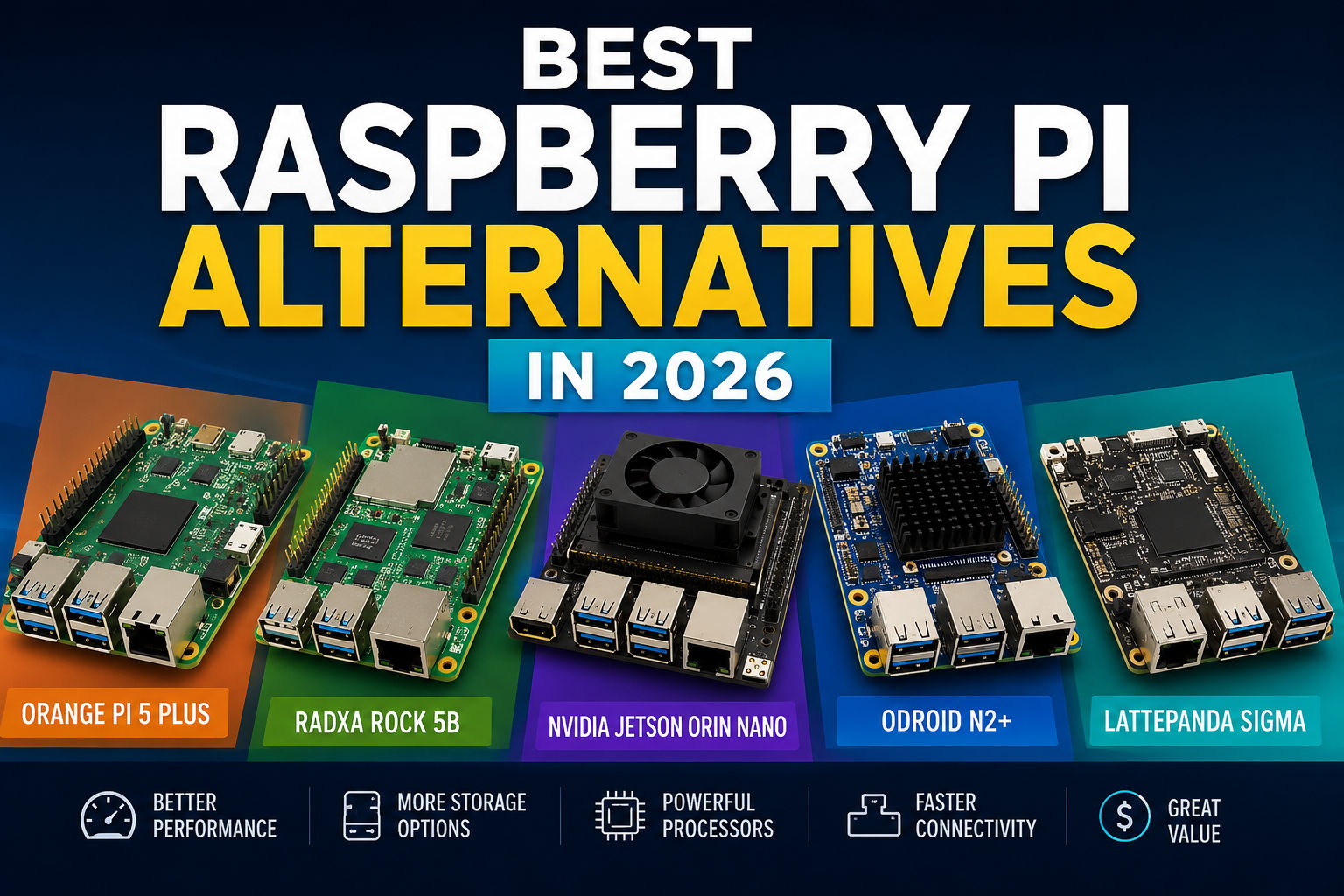
The Raspberry Pi remains one of the most popular single board computers in the world, but it’s no longer the only great option. Over the past few years, several manufacturers have released boards that offer more performance, additional features, or better value for specific use cases.
Whether you’re building a home server, an AI application, a robotics project, or simply looking for more computing power, there are excellent Raspberry Pi alternatives available in 2026.
This guide compares the best options and explains which board is the right choice for your project.
Why Look for a Raspberry Pi Alternative?
Although the Raspberry Pi ecosystem is excellent, it isn’t always the best solution.
You might want an alternative if you need:
- More CPU performance
- Additional RAM options
- Faster NVMe storage
- Better AI acceleration
- Multiple Ethernet ports
- x86 compatibility
- More USB connectivity
Many modern SBCs outperform the Raspberry Pi 5 in multi-core processing while maintaining similar power consumption.
Quick Comparison
| Board | Best For | CPU | RAM | Storage | Why Choose It |
|---|---|---|---|---|---|
| Orange Pi 5 Plus | Best Overall | RK3588 | Up to 16GB | NVMe | Outstanding performance and value |
| Radxa Rock 5B | Power Users | RK3588 | Up to 16GB | NVMe | Excellent Linux support |
| NVIDIA Jetson Orin Nano | AI Projects | ARM + GPU | 8GB | NVMe | AI inference and CUDA ecosystem |
| ODROID N2+ | Home Servers | Amlogic S922X | 4GB | eMMC | Stable and efficient |
| LattePanda Sigma | Windows & x86 | Intel Core | Up to 32GB | NVMe | Desktop-class compatibility |
1. Orange Pi 5 Plus — Best Overall Raspberry Pi Alternative
Best For
- Home servers
- Docker
- Virtualization
- Development
- Edge computing
The Orange Pi 5 Plus is arguably the strongest Raspberry Pi competitor today.
Powered by the Rockchip RK3588 processor, it delivers significantly better multi-core performance than the Raspberry Pi 5 while adding modern features like PCIe NVMe storage and dual 2.5 Gigabit Ethernet on some configurations.
Pros
✔ Excellent CPU performance
✔ NVMe SSD support
✔ Up to 16GB RAM
✔ Great value
Cons
- Smaller community than Raspberry Pi
- Some accessories are Pi-specific
2. Radxa Rock 5B — Best for Power Users
Best For
- Linux enthusiasts
- NAS
- Containers
- Development
The Radxa Rock 5B uses the same RK3588 family processor but focuses on strong Linux support and excellent storage expansion.
If you’re running Docker containers, databases, or self-hosted services, it’s an excellent choice.
Pros
✔ Excellent Linux compatibility
✔ NVMe support
✔ High CPU performance
✔ Active community
Cons
- Higher price than some competitors
- No official Raspberry Pi OS support
3. NVIDIA Jetson Orin Nano — Best for AI
Best For
- Computer vision
- Machine learning
- Robotics
- Edge AI
If your project involves AI inference or computer vision, the Jetson Orin Nano stands out thanks to NVIDIA’s CUDA ecosystem and dedicated AI acceleration. It offers significantly more AI performance than general-purpose ARM SBCs.
Pros
✔ CUDA support
✔ Excellent AI performance
✔ Strong developer ecosystem
Cons
- Expensive
- Overkill for simple projects
4. ODROID N2+ — Best for Home Servers
Best For
- Home Assistant
- Media servers
- NAS
- Always-on services
The ODROID N2+ has earned a reputation for reliability and efficient performance.
It consumes little power, boots quickly, and works well for lightweight server workloads. Many Home Assistant users choose it for its stability.
Pros
✔ Low power consumption
✔ Reliable
✔ Excellent Linux support
Cons
- Limited RAM compared to newer boards
5. LattePanda Sigma — Best x86 Alternative
Best For
- Windows
- Desktop software
- Development
- Virtual machines
Unlike ARM-based SBCs, the LattePanda Sigma uses an Intel processor, making it compatible with Windows and traditional x86 software.
If your applications require Windows or desktop-class compatibility, this is one of the best options.
Pros
✔ Windows compatibility
✔ Desktop-class performance
✔ Excellent expansion
Cons
- Higher price
- Higher power consumption
Which Raspberry Pi Alternative Should You Choose?
For Beginners
Choose:
It offers excellent performance while remaining affordable.
For Home Servers
Choose:
ODROID N2+
Reliable, efficient, and ideal for 24/7 operation.
For AI Projects
Choose:
Jetson Orin Nano
Its GPU and AI software stack make it the best option for computer vision and machine learning.
For Linux Enthusiasts
Choose:
Radxa Rock 5B
Excellent kernel support and storage options make it a favorite among advanced users.
For Windows Users
Choose:
LattePanda Sigma
The best option if you need native x86 compatibility.
Raspberry Pi vs Alternatives
| Feature | Raspberry Pi 5 | Modern Alternatives |
|---|---|---|
| Community | ⭐⭐⭐⭐⭐ | ⭐⭐⭐⭐ |
| Performance | ⭐⭐⭐⭐ | ⭐⭐⭐⭐⭐ |
| AI Capability | ⭐⭐ | ⭐⭐⭐⭐⭐ |
| Storage Options | ⭐⭐⭐ | ⭐⭐⭐⭐⭐ |
| Price | ⭐⭐⭐⭐⭐ | ⭐⭐⭐⭐ |
| Documentation | ⭐⭐⭐⭐⭐ | ⭐⭐⭐⭐ |
The Raspberry Pi still has the strongest ecosystem, but newer boards often offer better hardware for demanding workloads.
Things to Consider Before Buying
Before choosing an SBC, ask yourself:
What operating system will you use?
Some boards have excellent Linux support but limited Windows compatibility.
Do you need GPIO compatibility?
If you’re using Raspberry Pi HATs or accessories, check GPIO compatibility first.
Will you need NVMe storage?
For servers and databases, NVMe support is a major advantage.
How important is community support?
A large community means:
- More tutorials
- Faster troubleshooting
- Better software support
Frequently Asked Questions
What is the best Raspberry Pi alternative in 2026?
For most users, the Orange Pi 5 Plus offers the best balance of performance, features, and price. Users focused on AI may prefer the NVIDIA Jetson Orin Nano, while Home Assistant enthusiasts often choose the ODROID N2+.
Are Raspberry Pi alternatives compatible with Raspberry Pi accessories?
Many boards use a similar 40-pin GPIO header, but compatibility isn’t guaranteed. Always verify hardware and software support before purchasing.
Can Raspberry Pi OS run on other SBCs?
In most cases, no. Alternative boards typically use distributions such as Armbian, Ubuntu, Debian, or their own vendor-supported operating systems.
Is an alternative better than a Raspberry Pi?
It depends on your needs. If you prioritize documentation and community support, the Raspberry Pi remains an excellent choice. If you need higher performance, faster storage, or AI capabilities, several alternatives provide better hardware.
Final Thoughts
The Raspberry Pi continues to be one of the best single board computers for learning and general-purpose projects, but it’s no longer the only excellent choice.
If you want the best overall value, the Orange Pi 5 Plus is difficult to beat. For AI workloads, the NVIDIA Jetson Orin Nano leads the pack. If you’re building a home server, the ODROID N2+ remains one of the most dependable options.
The right board ultimately depends on your project, budget, and software requirements—not just benchmark numbers.
Related Guides
Continue learning with these articles on single-board.computer: