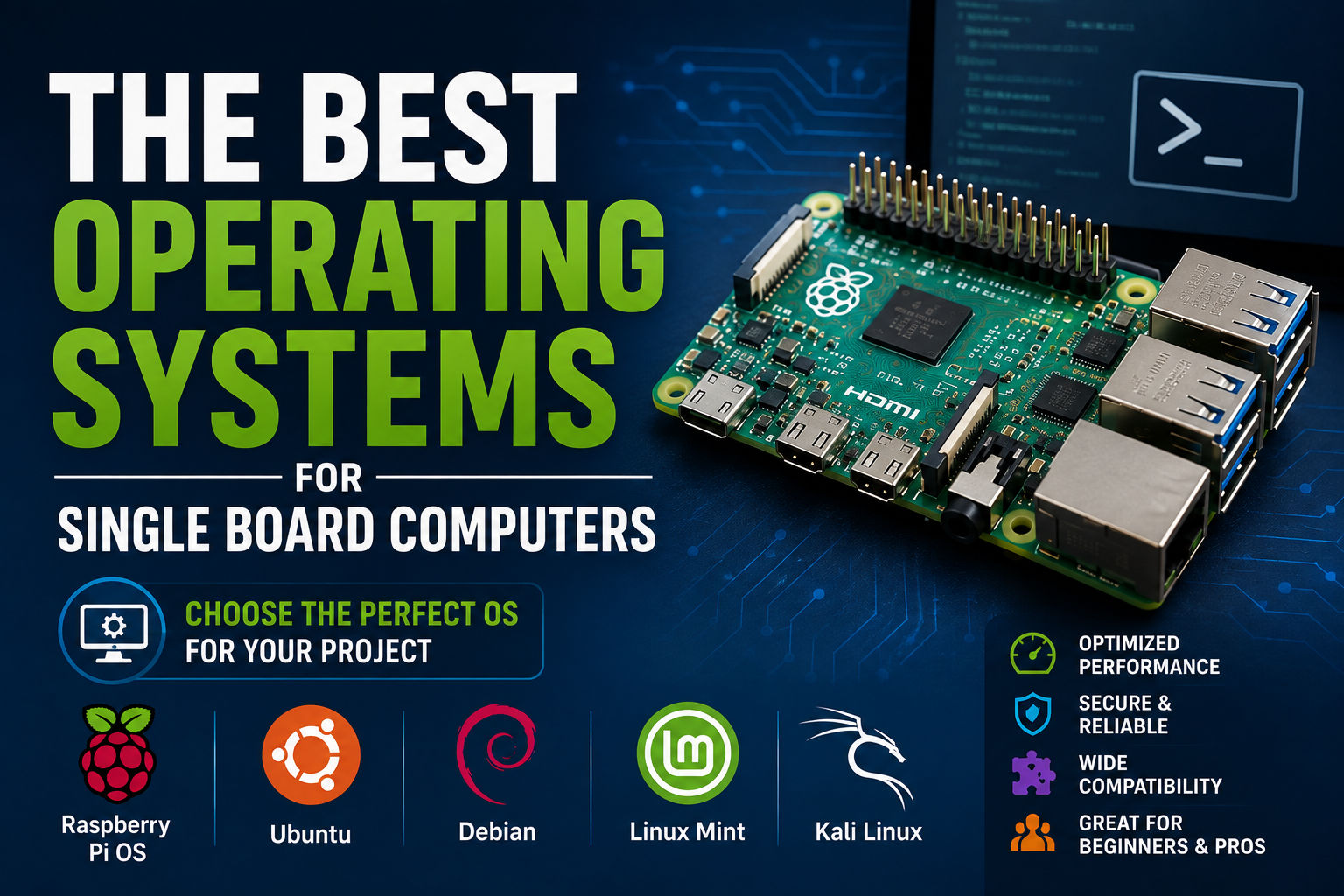
Choosing the right operating system (OS) is just as important as choosing the right hardware. A powerful single board computer (SBC) can feel slow or limited if the OS doesn’t match your project.
In this guide, we’ll break down the best operating systems for single board computers, what they’re good for, and when you should use each one.
1️⃣ Raspberry Pi OS (Best for Beginners)
Best for: Beginners, education, general projects
Based on: Debian Linux
If you’re using a Raspberry Pi or a compatible board, Raspberry Pi OS is usually the easiest starting point.
Why it’s great
- Optimized for Pi hardware
- Massive community support
- Preinstalled tools for Python and GPIO
- Stable and beginner-friendly
When to use it
- First SBC project
- Learning Linux
- Basic home automation
- Desktop-style usage
If you’re new to SBCs, this is the safest choice.
2️⃣ Ubuntu (Best All-Around Linux Option)
Best for: Servers, development, containers
Available as: Ubuntu Server, Ubuntu Desktop
Ubuntu runs well on many ARM-based SBCs and x86 boards.
Why it’s great
- Familiar Linux environment
- Excellent package support
- Works well with Docker
- Great for web servers and development
When to use it
- Hosting services (VPN, web server, NAS)
- Development environments
- IoT gateways
- Cloud-connected systems
If you want flexibility and long-term stability, Ubuntu is a strong pick.
3️⃣ Armbian (Best for Non-Raspberry Pi Boards)
Best for: Orange Pi, NanoPi, Odroid, Radxa
Armbian is a lightweight Linux distribution optimized for ARM-based SBCs outside the Raspberry Pi ecosystem.
Why it’s great
- Hardware-specific optimizations
- Lightweight and fast
- Active developer community
- Minimal bloat
When to use it
- Running a headless server
- Performance-focused builds
- Non-Pi boards
For many alternative SBCs, Armbian is the best-supported Linux option.
4️⃣ Home Assistant OS (Best for Smart Home Projects)
Best for: Dedicated smart home hubs
If your goal is home automation, Home Assistant OS turns your SBC into a complete smart home controller.
Why it’s great
- Purpose-built system
- Simple installation
- Built-in automation tools
- Large plugin ecosystem
When to use it
- Smart lighting control
- Energy monitoring
- Zigbee/Z-Wave hubs
This is a specialized OS, but perfect for a single-purpose device.
5️⃣ Android (Best for Media & Touchscreen Projects)
Best for: Media centers, kiosks, touch interfaces
Some SBCs support Android builds, making them ideal for media and display applications.
Why it’s great
- Familiar interface
- App ecosystem
- Good multimedia support
When to use it
- Digital signage
- Touchscreen dashboards
- Media playback devices
Android is less common for server projects, but strong for multimedia use cases.
6️⃣ DietPi (Best Lightweight Option)
Best for: Low-RAM systems
DietPi is a highly optimized and minimal Linux OS designed for SBCs.
Why it’s great
- Extremely lightweight
- Fast performance
- Easy software installer
- Ideal for headless systems
When to use it
- Pi-hole
- Small web servers
- Lightweight IoT gateways
If your board has limited RAM, DietPi can make a big difference.
7️⃣ Windows IoT / Windows on ARM (Limited Use Cases)
Best for: Specific enterprise or Windows-dependent projects
Windows IoT exists for certain SBCs, but Linux dominates the SBC world.
When to consider it
- Windows-based IoT development
- Enterprise environments
- Specialized Microsoft ecosystems
For most users, Linux remains the better choice.
🧠 How to Choose the Right OS
Here’s a quick decision table:
| Use Case | Recommended OS |
|---|---|
| Beginner learning | Raspberry Pi OS |
| Home server | Ubuntu Server |
| Non-Pi ARM board | Armbian |
| Smart home hub | Home Assistant OS |
| Media center | Android or Raspberry Pi OS |
| Lightweight build | DietPi |
⚡ Key Factors to Consider
Before choosing an OS, ask:
- Does my board officially support it?
- Do I need a desktop or headless setup?
- How much RAM do I have?
- Will I use Docker or containers?
- Is community support strong?
Software support can matter more than hardware specs.
🚀 Final Thoughts
Linux-based systems dominate the SBC ecosystem for a reason: stability, flexibility, and massive community support.
If you’re just starting:
- Use Raspberry Pi OS (for Pi boards)
- Use Armbian (for non-Pi ARM boards)
If you’re building servers or advanced projects:
- Ubuntu Server is hard to beat.
The best operating system for your single board computer depends entirely on what you plan to build.