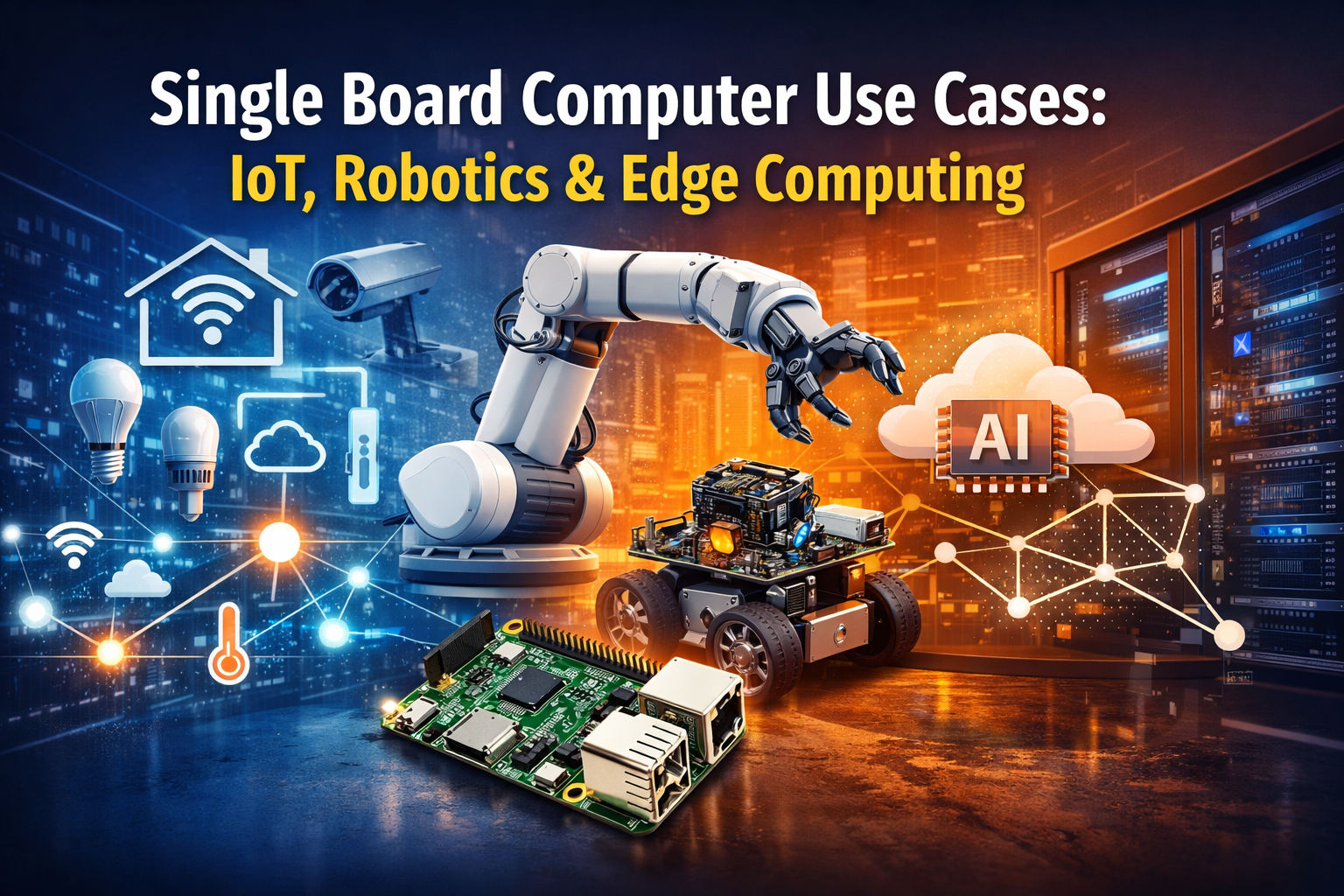
Single board computers (SBCs) are no longer just “tiny computers for hobbyists.” In 2026, they’re used everywhere—from smart homes and industrial sensors to robotics and edge AI deployments.
If you’re wondering what a single board computer is used for, this guide breaks down the most common real-world SBC use cases: IoT, robotics, and edge computing—plus a few bonus applications that beginners love.
Why Single Board Computers Are Used in So Many Projects
Before we dive into use cases, it helps to understand why SBCs are so popular:
- Small and lightweight
- Low power consumption
- Affordable
- Flexible (Linux + open-source software)
- Good connectivity (USB, Ethernet, Wi-Fi, GPIO)
This combination makes them ideal for systems that need to run continuously or fit into small spaces.
1) Single Board Computers in IoT (Internet of Things)
What SBCs Do in IoT
In IoT projects, SBCs typically act as:
- A device controller
- A sensor gateway
- A local server
- A data collector
Unlike microcontrollers, an SBC can run a full OS, handle networking, and process data locally.
Common IoT Use Cases for SBCs
✅ Smart Home Automation Hub
SBCs are often used to run:
- Home Assistant
- MQTT brokers
- Zigbee / Z-Wave controllers
- Node-RED automations
A single board computer can act as the brain of your smart home.
✅ IoT Sensor Gateway
SBCs can collect data from:
- temperature sensors
- motion sensors
- industrial sensors
- smart meters
Then forward the data to the cloud or store it locally.
✅ Local Data Logging
Instead of pushing everything to the cloud, SBCs can log data locally using:
- SQLite
- InfluxDB
- lightweight dashboards
This is perfect for remote sites where internet is unreliable.
Why SBCs Work Well for IoT
- Built-in networking
- Runs Linux services
- Supports databases and containers
- Easy to integrate with sensors via GPIO/I2C/SPI
2) Single Board Computers in Robotics
Robotics is one of the most exciting areas for SBCs because robots need:
- computing power
- real-time decision-making
- connectivity
- sensor integration
SBCs are often the “main brain” in small and mid-sized robots.
Common Robotics Use Cases for SBCs
🤖 Autonomous Mobile Robots
SBCs can handle:
- navigation logic
- sensor fusion
- motor control coordination
- mapping (SLAM in advanced builds)
🤖 Robot Vision and Object Detection
Some SBCs support:
- camera modules
- hardware video acceleration
- AI inference (depending on the board)
This enables:
- face detection
- object tracking
- line following
- quality inspection
🤖 Drones and UAV Support Systems
SBCs are used in drones for:
- telemetry
- video streaming
- companion computing
- advanced flight logic
Why SBCs Work Well for Robotics
- Support for cameras and sensors
- Easy programming (Python, C++)
- Runs ROS / ROS2 (depending on board)
- Small enough to mount inside robots
3) Single Board Computers in Edge Computing
What Is Edge Computing?
Edge computing means processing data near the source, instead of sending everything to the cloud.
SBCs are widely used in edge computing because they can run:
- Linux
- containers (Docker)
- AI models (lightweight)
- local dashboards and APIs
Common Edge Computing Use Cases for SBCs
⚡ Edge AI and Machine Learning
SBCs can run local inference for:
- security cameras
- retail analytics
- traffic monitoring
- predictive maintenance
Even when they can’t train models, they can still run inference efficiently.
⚡ Industrial Monitoring and Predictive Maintenance
SBCs can collect machine data from:
- vibration sensors
- temperature sensors
- power draw sensors
Then analyze it locally and send only useful insights upstream.
⚡ Smart Retail and Smart Cities
SBCs are used for:
- people counting
- environmental sensors
- signage systems
- real-time alerts
Why SBCs Work Well for Edge Computing
- Low power = always-on deployment
- Compact = easy installation
- Can run modern Linux stacks
- Good networking (Ethernet + Wi-Fi)
Bonus: Other Popular SBC Use Cases
Even though IoT, robotics, and edge computing are the “big three,” SBCs are also widely used for:
🎬 Media Centers
- Kodi
- Plex clients
- streaming systems
🧰 Home Servers
- file server (NAS-lite)
- Pi-hole DNS filtering
- VPN server
- web server
🧑🎓 Education
SBCs are perfect for learning:
- Linux
- Python
- networking
- basic electronics
🔐 Cybersecurity Labs
SBCs can be used for:
- portable monitoring
- network scanning
- honeypots (with caution)
- isolated training environments
(As a cybersecurity professional, you already know how useful small, isolated systems can be.)
How to Choose the Right SBC for Each Use Case
Here’s a quick guide:
| Use Case | What Matters Most |
|---|---|
| IoT Hub | Networking, reliability, low power |
| Robotics | GPIO, sensor support, performance |
| Edge Computing | CPU power, RAM, fast storage |
| Media Center | GPU, HDMI, decoding support |
| Home Server | Ethernet, NVMe/eMMC storage |
| Learning | Community + documentation |
Final Thoughts
Single board computers are popular because they sit in the perfect middle ground:
- more powerful than microcontrollers
- cheaper and smaller than PCs
- flexible enough for real-world deployments
Whether you’re building an IoT gateway, a robot, or an edge computing device, a good SBC can handle the job—efficiently and reliably.
Next Articles to Read
If you want to continue exploring, these go perfectly with this guide: