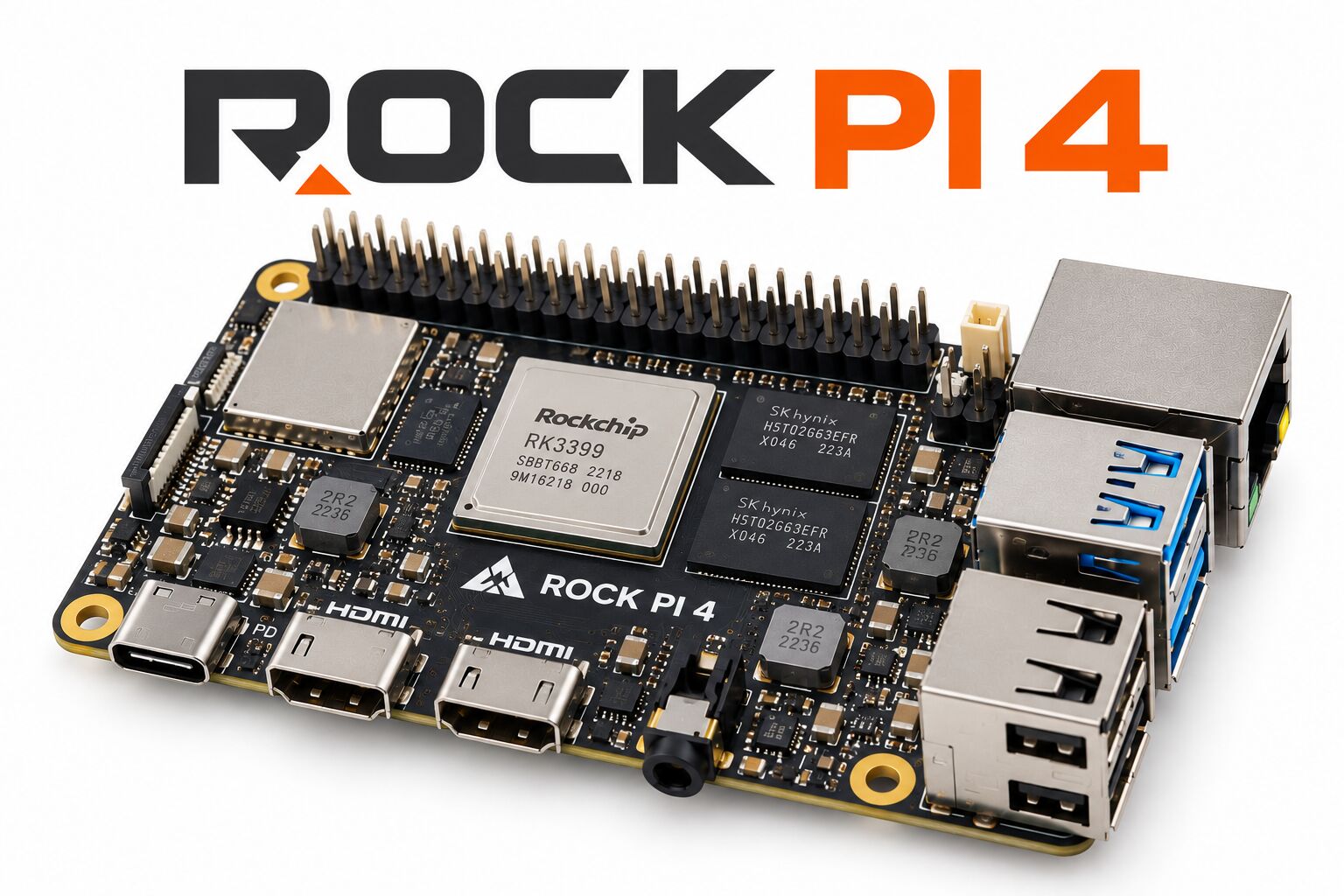
CPU: Rockchip RK3399 1800 MHz | 6 Cores | ARMv8
RAM: 4096 MB LPDDR4
Ethernet Interfaces Qty: 1
Gigabit Ethernet: Yes
USB Ports Qty: 4
USB 3.0: Yes
Wi-Fi+BT: Yes
Wi-Fi 6: No
NVMe Port: Yes
The ROCK Pi 4 is a powerful single-board computer from Radxa built around the Rockchip RK3399 processor. It combines six ARM CPU cores, LPDDR4 memory, Gigabit Ethernet, Wi-Fi, Bluetooth, USB 3.0, NVMe support and a 40-pin GPIO header in a compact board.
The ROCK Pi 4 was designed as a higher-performance alternative to earlier Raspberry Pi generations and is particularly interesting for Linux servers, desktop computing, storage projects, development, networking and maker applications.
The original ROCK Pi 4 family includes several configurations and revisions, including the ROCK Pi 4A, 4B and 4C. Hardware specifications vary between these versions, particularly regarding wireless connectivity, eMMC and display connectors.
Note: This page covers the original ROCK Pi 4 family. Later models such as the ROCK 4A+, ROCK 4B+, ROCK 4 SE and ROCK 4C+ use different processors or hardware configurations and should be treated as separate products.
ROCK Pi 4 Specifications
| Specification | ROCK Pi 4 |
|---|---|
| SoC | Rockchip RK3399 |
| CPU | 2 × Cortex-A72 + 4 × Cortex-A53 |
| CPU speed | Up to 1.8GHz |
| GPU | Mali-T860 MP4 |
| RAM | 1GB / 2GB / 4GB LPDDR4 |
| Storage | microSD, eMMC, NVMe |
| Ethernet | Gigabit Ethernet |
| Wi-Fi | 802.11ac on supported models |
| Bluetooth | Bluetooth 5.0 on supported models |
| USB | USB 3.0 + USB 2.0 |
| Display | HDMI up to 4K60 |
| Camera | MIPI CSI |
| Display interface | MIPI DSI |
| GPIO | 40-pin |
| PCIe | PCIe 2.1 |
| Audio | 3.5mm audio jack with microphone |
| Power | USB-C / PD or QC depending on model |
| Form factor | Compact SBC |
The RK3399 combines two high-performance Cortex-A72 cores with four lower-power Cortex-A53 cores and includes a Mali-T860 MP4 GPU.
Rockchip RK3399 Processor
The processor is one of the main reasons to consider the ROCK Pi 4.
The Rockchip RK3399 uses ARM’s big.LITTLE architecture:
- 2 × Cortex-A72 cores at up to 1.8GHz
- 4 × Cortex-A53 cores at up to 1.4GHz
- Mali-T860 MP4 GPU
The two Cortex-A72 cores provide higher performance for demanding workloads, while the four Cortex-A53 cores are designed for lower-power tasks.
This six-core design gives the ROCK Pi 4 considerably more CPU flexibility than many older quad-core SBCs.
ROCK Pi 4 Memory
The original ROCK Pi 4 family was available with different memory configurations.
Depending on the model and revision, configurations include:
- 1GB
- 2GB
- 4GB
The memory is 64-bit dual-channel LPDDR4 running at 3200Mb/s.
For a desktop or server installation, the 4GB version is preferable when available.
For lightweight embedded applications, 1GB or 2GB can be sufficient.
ROCK Pi 4 Storage
Storage is one of the ROCK Pi 4’s strongest features.
Depending on the model, you can use:
- microSD
- eMMC
- NVMe SSD
The ROCK Pi 4 includes an M.2 interface capable of supporting NVMe SSDs through its PCIe connection. Radxa specifies support for M.2 NVMe storage and capacities up to 2TB in its documentation.
This is particularly useful for server applications.
Instead of:
ROCK Pi 4
    │
 microSD
you can build:
ROCK Pi 4
    │
   PCIe
    │
M.2 NVMe SSD
For databases, file servers, development environments and other storage-intensive applications, NVMe provides a much more attractive storage solution than relying exclusively on a microSD card.
ROCK Pi 4 eMMC Storage
Another advantage of the ROCK Pi 4 platform is its support for eMMC storage.
The original 4A/4B/4C family uses different eMMC configurations depending on the model.
Some versions provide an eMMC module connector, while the ROCK Pi 4B was offered with onboard eMMC configurations.
eMMC can be useful when you want more reliable onboard storage than a conventional microSD card while keeping the board compact.
ROCK Pi 4 Networking
The ROCK Pi 4 includes Gigabit Ethernet.
This makes it particularly well suited to:
- Home servers
- NAS projects
- Network applications
- Web servers
- Docker
- Development servers
- File sharing
- Network monitoring
Radxa specifically highlights the board’s Gigabit Ethernet connection and dedicated network controller.
Some ROCK Pi 4 versions also include wireless networking.
The ROCK Pi 4B, for example, includes 802.11ac Wi-Fi 5 and Bluetooth 5.0.
Because the different ROCK Pi 4 revisions aren’t identical, check the exact model before assuming Wi-Fi and Bluetooth are included.
ROCK Pi 4 USB Ports
The ROCK Pi 4 provides a useful selection of USB connectivity.
The ROCK Pi 4B product brief specifies:
- 1 × USB 3.0 host
- 2 × USB 2.0 host
- 1 × USB 3.0 OTG
This gives you substantially more flexibility for external peripherals than very small SBCs such as the Raspberry Pi Zero 2 W.
USB devices can include:
- External SSDs
- Hard drives
- Keyboards
- Mice
- USB network adapters
- Cameras
- Controllers
- Storage devices
ROCK Pi 4 Display Support
The ROCK Pi 4 supports HDMI video output at up to 4K resolution at 60Hz.
It can also use its MIPI DSI interface for compatible displays.
This makes the ROCK Pi 4 suitable for:
- Linux desktops
- Digital signage
- Kiosks
- Media centers
- Industrial displays
- Touchscreen projects
The exact display configuration depends on the ROCK Pi 4 revision.
ROCK Pi 4 Graphics
Graphics are provided by the Mali-T860 MP4 GPU.
Radxa lists support for:
- OpenGL ES
- Vulkan 1.0
- OpenCL
- DirectX 11
The ROCK Pi 4 can also perform hardware video decoding, including H.265/HEVC up to 4Kp60 and H.264 up to 1080p60 according to the ROCK Pi 4B product brief.
This makes the board capable of more than basic server workloads.
ROCK Pi 4 GPIO
The ROCK Pi 4 includes a 40-pin GPIO interface.
The GPIO header provides access to interfaces such as:
- UART
- SPI
- I²C
- PWM
- ADC
- I²S
- GPIO
The 40-pin layout was designed to provide compatibility with a range of maker accessories and Raspberry Pi-style expansion hardware, although software and pin compatibility should always be checked before assuming a particular Raspberry Pi HAT will work.
This makes the ROCK Pi 4 suitable for:
- Sensors
- LEDs
- Displays
- Robotics
- Automation
- Electronics projects
- Industrial prototypes
ROCK Pi 4 Camera Support
The ROCK Pi 4 provides a MIPI CSI camera interface.
This allows you to connect compatible camera modules for applications such as:
- Security cameras
- Computer vision
- Robotics
- Time-lapse photography
- Industrial monitoring
- AI experiments
The exact camera support depends on the operating system and drivers being used.
ROCK Pi 4 Audio
The board includes a 3.5mm audio jack with microphone input on supported configurations.
This is useful for:
- Media centers
- Voice projects
- Internet radio
- Audio applications
- Kiosks
- Development projects
The availability and implementation of audio features can vary between ROCK Pi 4 revisions.
ROCK Pi 4 Operating Systems
The ROCK Pi 4 can run several operating systems and Linux distributions.
Radxa’s documentation lists support for Android and Linux distributions.
The actual software experience depends heavily on the specific distribution, kernel and hardware revision.
Before starting a project, check that the operating system you intend to use supports:
- Your exact ROCK Pi 4 revision
- Wi-Fi hardware
- Bluetooth
- NVMe
- GPIO
- Camera
- Display
- Hardware acceleration
This is particularly important with older SBC platforms because software support can vary considerably between distributions.
ROCK Pi 4 for Linux Desktop
The ROCK Pi 4’s six-core processor, up to 4GB of RAM and 4K display support make it capable of running a Linux desktop.
It can be used for:
- Web browsing
- Programming
- Office applications
- Terminal work
- Linux experimentation
- Lightweight development
However, modern Raspberry Pi boards and newer ARM SBCs offer considerably more performance.
The ROCK Pi 4 is therefore most interesting when you specifically want its RK3399 platform, NVMe capability or other hardware features.
ROCK Pi 4 as a Home Server
The ROCK Pi 4 can make a capable home server.
Its combination of:
Gigabit Ethernet + NVMe + up to 4GB RAM
is particularly attractive for server projects.
Possible applications include:
- File server
- Web server
- Docker
- Nextcloud
- Home automation
- Network services
- VPN
- Development server
- Media server
A typical setup could look like:
             ROCK Pi 4
                 │
        ┌────────┴────────┐
        │                 │
     Gigabit            NVMe
     Ethernet             │
        │              Storage
        │
     Network
The NVMe interface is one of the reasons the ROCK Pi 4 remains interesting for storage-focused SBC projects.
ROCK Pi 4 for Docker
The ROCK Pi 4 is well suited to Docker-based projects, especially when using the 4GB configuration.
You can run multiple lightweight services on the same machine.
For example:
ROCK Pi 4
   │
 Docker
   │
 ├── Web server
 ├── Database
 ├── Pi-hole
 ├── Tailscale
 └── Monitoring
The actual number of containers you can run depends on their memory and CPU requirements.
The 4GB version is the preferable configuration if you intend to use the board as a general-purpose Docker server.
ROCK Pi 4 for NAS Projects
The ROCK Pi 4 is an interesting platform for a small NAS or file server because it combines Gigabit Ethernet with fast storage options.
An NVMe SSD can be connected through the M.2 interface, while USB ports can provide additional storage connectivity.
A simple setup could use:
- ROCK Pi 4
- NVMe SSD
- Gigabit Ethernet
- External USB storage
For more demanding NAS applications, however, dedicated NAS hardware may provide better drive connectivity and redundancy.
ROCK Pi 4 for Media Centers
The ROCK Pi 4 supports 4K HDMI output and hardware video decoding.
This makes it suitable for media-oriented projects, provided that the chosen operating system has the necessary hardware acceleration and application support.
It can be used for:
- Media centers
- Digital signage
- Streaming clients
- 4K displays
- Kiosk systems
Software support is an important consideration, particularly for hardware-accelerated video playback.
ROCK Pi 4 for Retro Gaming
The ROCK Pi 4’s six-core processor and Mali GPU make it capable of retro gaming and emulation.
It can handle a range of older gaming platforms, although results vary significantly depending on the emulator and operating system.
For retro gaming, consider the ROCK Pi 4 if you already have one or specifically want an RK3399-based system.
For a new purchase, newer SBCs may offer better performance and longer software support.
ROCK Pi 4 Power
Power requirements vary between ROCK Pi 4 revisions.
Radxa recommends USB Power Delivery or Quick Charge power for some original ROCK Pi 4 models, while later hardware revisions have different power configurations.
For the original ROCK Pi 4, choosing the correct power supply is important.
An inadequate power supply can cause:
- Instability
- Unexpected shutdowns
- Storage errors
- USB problems
- Performance issues
Always check the power requirements for your exact ROCK Pi 4 revision.
ROCK Pi 4 Cooling
The RK3399 can generate considerable heat under sustained workloads.
For server, desktop, compilation and other CPU-intensive applications, active cooling is recommended.
A heatsink and fan can help maintain performance and prevent thermal throttling.
This is especially important when running the ROCK Pi 4 continuously as a server.
ROCK Pi 4 Models
One complication when researching the ROCK Pi 4 is that “ROCK Pi 4” refers to a family rather than a single completely identical board.
The original family includes:
- ROCK Pi 4A
- ROCK Pi 4B
- ROCK Pi 4C
Later variants include:
- ROCK 4A+
- ROCK 4B+
- ROCK 4 SE
- ROCK 4C+
These models aren’t interchangeable from a specification perspective.
For example, the ROCK Pi 4B includes Wi-Fi and Bluetooth, while the original 4A does not. The 4B also uses different storage and display configurations from some other variants.
When buying a used ROCK Pi 4, verify the exact model and hardware revision.
ROCK Pi 4 vs Raspberry Pi
The ROCK Pi 4 was designed as an alternative to Raspberry Pi-class SBCs, but the two platforms have different strengths.
| Feature | ROCK Pi 4 | Raspberry Pi 4 |
|---|---|---|
| CPU | 6-core RK3399 | 4-core Cortex-A72 |
| RAM | Up to 4GB on original models | Up to 8GB |
| NVMe | Built-in M.2 interface | Requires adapter/HAT |
| Ethernet | Gigabit | Gigabit |
| Wi-Fi | Available on some models | Built in |
| GPIO | 40-pin | 40-pin |
| HDMI | Up to 4K60 | Up to dual displays |
| Community | Smaller | Much larger |
| Software ecosystem | Smaller | Larger |
The ROCK Pi 4’s M.2 NVMe support is one of its most interesting advantages.
The Raspberry Pi ecosystem, however, has a much larger user and software community.
Is the ROCK Pi 4 Still Worth Buying?
The answer depends heavily on the price.
The ROCK Pi 4 is an older SBC platform based on the RK3399, so it shouldn’t be evaluated in the same way as a current-generation Raspberry Pi 5.
However, it remains useful if you can obtain one at a reasonable price.
Its strongest features are still attractive:
- Six-core CPU
- Up to 4GB LPDDR4
- Gigabit Ethernet
- NVMe support
- eMMC options
- 40-pin GPIO
- 4K60 HDMI
- Wi-Fi and Bluetooth on supported models
The main concern is software and ecosystem support.
A newer SBC can provide substantially better performance and potentially longer software support.
Who Should Buy the ROCK Pi 4?
The ROCK Pi 4 is best suited for users who want:
- An RK3399-based SBC
- NVMe storage
- A compact Linux server
- A development board
- A home server
- A maker platform
- GPIO projects
- A small NAS
- A media system
- An inexpensive used SBC
It is less attractive if you simply want the fastest SBC available for a new project.
ROCK Pi 4 Pros and Cons
Pros
- Six-core ARM processor
- Up to 4GB LPDDR4
- Gigabit Ethernet
- NVMe support
- eMMC support
- 4K60 HDMI
- 40-pin GPIO
- Wi-Fi and Bluetooth on supported models
- USB 3.0
- Compact form factor
- Good storage options
Cons
- Older RK3399 platform
- Only up to 4GB RAM on original ROCK Pi 4 models
- Software ecosystem is smaller than Raspberry Pi
- Different revisions have significantly different hardware
- Power requirements vary by model
- Cooling is recommended under sustained loads
- Availability can be more difficult than Raspberry Pi hardware
ROCK Pi 4: Final Verdict
The ROCK Pi 4 remains an interesting single-board computer for users who value storage flexibility and the RK3399 platform.
Its combination of a six-core processor, LPDDR4 memory, Gigabit Ethernet, NVMe support, GPIO and 4K video output makes it considerably more capable than many older SBCs.
Its biggest weakness today isn’t necessarily the hardware itself.
It’s the age of the platform and smaller software ecosystem.
If you already own a ROCK Pi 4, it remains capable of running many useful projects. If you’re buying one used at a good price, it can also make an inexpensive home server or development system.
For a new build where maximum performance and long-term software support are priorities, newer SBCs are generally a better choice.
Rating
| Category | Rating |
|---|---|
| Performance | 4/5 |
| Storage | 4.5/5 |
| Connectivity | 4/5 |
| Expansion | 4.5/5 |
| Software ecosystem | 3.5/5 |
| Value | 4/5 |
| Overall | 4/5 |
Best for: Home servers, NVMe storage projects, development, networking and maker applications.
Frequently Asked Questions
What processor does the ROCK Pi 4 use?
The original ROCK Pi 4 uses the Rockchip RK3399, with two Cortex-A72 cores and four Cortex-A53 cores.
How much RAM does the ROCK Pi 4 have?
Original ROCK Pi 4 models were offered with up to 4GB of LPDDR4 RAM, with different configurations available depending on the model.
Does the ROCK Pi 4 support NVMe?
Yes. The ROCK Pi 4 includes an M.2 interface supporting NVMe SSDs through PCIe.
Does ROCK Pi 4 have Gigabit Ethernet?
Yes. The ROCK Pi 4 includes Gigabit Ethernet.
Does ROCK Pi 4 have Wi-Fi?
It depends on the model. The ROCK Pi 4B includes 802.11ac Wi-Fi and Bluetooth 5.0, while some other variants do not have the same wireless hardware.
Can ROCK Pi 4 run Linux?
Yes. ROCK Pi 4 supports Linux distributions as well as Android.
Can ROCK Pi 4 run Docker?
Yes. The 4GB configuration is particularly suitable for running multiple lightweight Docker containers.
Can ROCK Pi 4 run a NAS?
Yes. Its Gigabit Ethernet, USB ports and NVMe support make it suitable for small NAS and file-server projects.
Does ROCK Pi 4 support 4K?
Yes. The ROCK Pi 4 supports HDMI output up to 4K at 60Hz on the relevant models.
Does ROCK Pi 4 have GPIO?
Yes. It has a 40-pin GPIO interface with support for interfaces including SPI, I²C, UART and PWM.