CPU: CIX P1 / CD8180 2600 MHz | 12 Cores | ARMv9
RAM: 32768 MB LPDDR5
Ethernet Interfaces Qty: 2
Gigabit Ethernet: Yes
USB Ports Qty: 4
USB 3.0: Yes
Wi-Fi+BT: No
Wi-Fi 6: No
NVMe Port: Yes
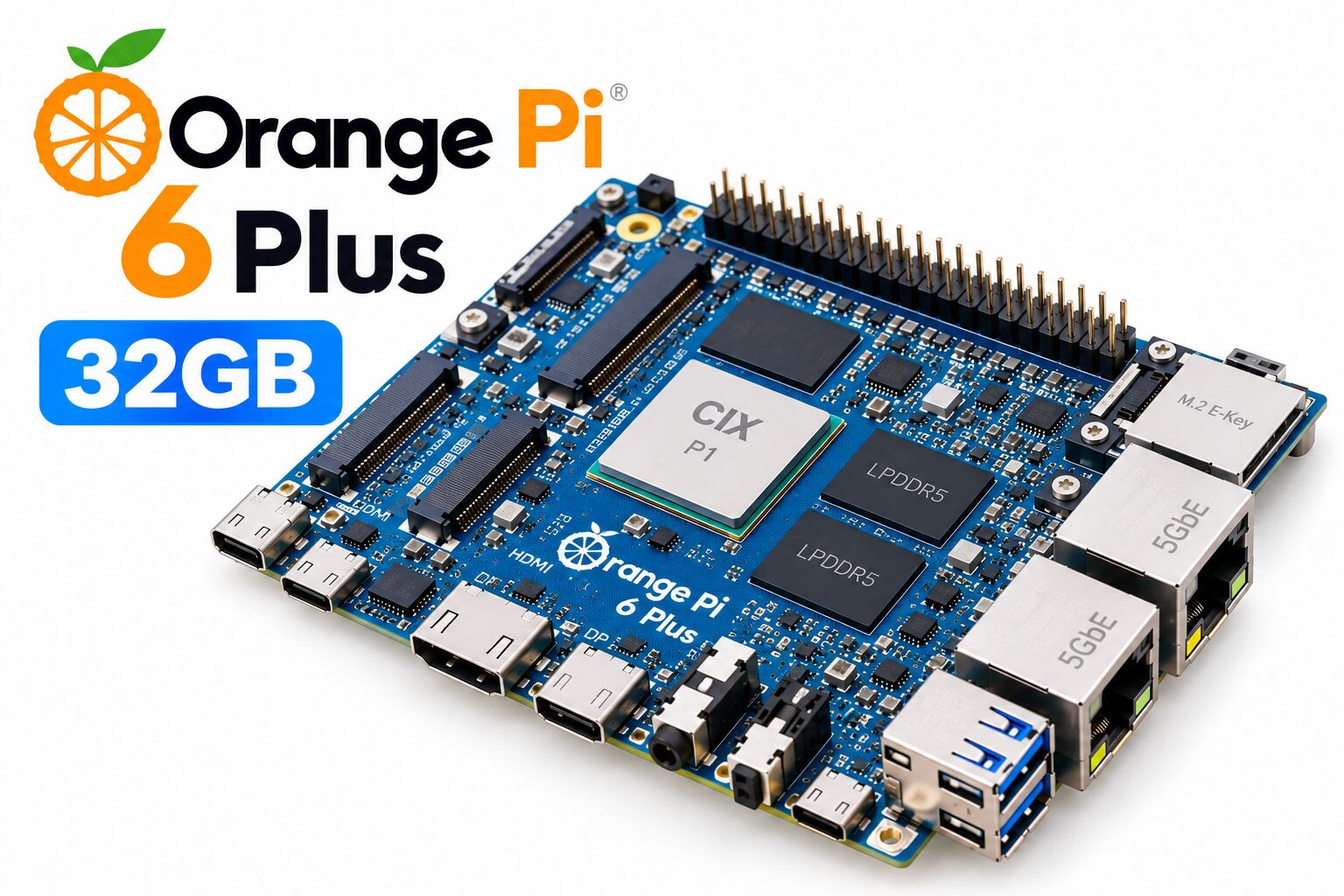
The Orange Pi 6 Plus 32GB is a high-performance single-board computer built around the CIX P1 (CD8180/CD8160) 12-core Arm processor. It combines 32GB of 128-bit LPDDR5 memory, an Arm Immortalis-G720 MC10 GPU, a dedicated NPU, dual 5GbE networking and two PCIe 4.0 x4 M.2 NVMe interfaces.
Unlike the standard Orange Pi 6, the 6 Plus is the larger model, measuring 115 × 100 mm and providing two 5GbE ports. It is available with 16GB, 32GB and 64GB LPDDR5 configurations.
The 32GB version is particularly suited to demanding Linux applications, Docker, development, AI workloads, high-speed networking, NAS projects and home-lab servers.
Orange Pi 6 Plus 32GB Specifications
| Specification | Orange Pi 6 Plus 32GB |
|---|---|
| SoC | CIX P1 / CD8180 |
| CPU | 12-core 64-bit Arm |
| CPU configuration | 4 × Cortex-A720 + 4 × Cortex-A720 + 4 × Cortex-A520 |
| Maximum CPU frequency | Up to 2.6 GHz |
| GPU | Arm Immortalis-G720 MC10 |
| GPU | Vulkan 1.3, OpenGL ES 3.2, OpenCL 3.0, hardware ray tracing |
| NPU | Up to 28.8 TOPS |
| Combined AI compute | Up to 45 TOPS |
| RAM | 32GB LPDDR5 |
| Memory bus | 128-bit |
| Memory speed | Up to 6000 MT/s |
| Storage | microSD + SPI flash |
| NVMe | 2 × M.2 M-Key PCIe 4.0 x4 |
| Ethernet | 2 × 5GbE |
| Wireless | M.2 E-Key |
| USB 3 | 2 × USB 3.0/3.2 Host |
| USB 2 | 2 × USB 2.0 Host |
| USB-C | 2 × USB-C |
| HDMI | Up to 4K60 |
| DisplayPort | Up to 4K120 |
| GPIO | 40-pin |
| Camera | 2 × 4-lane MIPI CSI |
| Audio | 3.5mm audio + speaker/microphone interfaces |
| Power | USB-C PD, 20V |
| Dimensions | 115 × 100 mm |
| Weight | Approximately 132 g |
The official hardware documentation lists 16GB, 32GB and 64GB LPDDR5 options, two PCIe 4.0 x4 M.2 slots, dual 5GbE, multiple USB interfaces and the CIX P1 platform.
CIX P1 12-Core Processor
The Orange Pi 6 Plus uses the CIX P1, also identified as the CD8180/CD8160 platform.
The processor has 12 Arm CPU cores:
- 4 × Cortex-A720 performance cores
- 4 × Cortex-A720 cores
- 4 × Cortex-A520 efficiency cores
The currently documented configuration operates with frequencies up to 2.6 GHz for the highest-performance cores.
This gives the Orange Pi 6 Plus a substantial amount of CPU capacity for workloads that can take advantage of multiple cores.
Potential applications include:
- Linux servers
- Docker
- Software development
- Databases
- Compiling software
- Virtualization experiments
- AI applications
- Network services
- Home labs
32GB LPDDR5 Memory
The most notable feature of this version is its 32GB of LPDDR5 RAM.
The memory uses a 128-bit interface, with the hardware documentation listing speeds up to 6000 MT/s.
Having 32GB of memory gives the board considerably more room for applications that would exceed the memory capacity of conventional SBCs.
Possible applications include:
- Multiple Docker containers
- Databases
- Development environments
- Large software builds
- AI inference
- Computer vision
- Virtual machines
- High-memory servers
- Local development environments
- Self-hosted services
The Orange Pi 6 Plus is also available with 16GB and 64GB configurations.
Immortalis-G720 MC10 GPU
The CIX P1 includes an Arm Immortalis-G720 MC10 GPU.
The GPU supports:
- Vulkan 1.3
- OpenGL ES 3.2
- OpenCL 3.0
- Hardware ray tracing
This gives the Orange Pi 6 Plus considerably more graphics capability than many traditional SBC platforms.
The GPU can be used for:
- Linux desktop graphics
- 3D applications
- GPU-accelerated workloads
- Multimedia
- Graphics development
- Computer vision
- AI workloads that use GPU acceleration
Software support remains important, particularly for Linux GPU acceleration and applications that depend on specific drivers.
NPU and AI Acceleration
The Orange Pi 6 Plus includes a dedicated NPU capable of up to 28.8 TOPS.
Orange Pi also describes the platform as providing up to 45 TOPS of combined CPU, GPU and NPU compute.
The NPU supports:
- INT4
- INT8
- INT16
- FP16
- BF16
- TF32
Potential applications include:
- AI inference
- Computer vision
- Object detection
- Image classification
- Robotics
- Smart cameras
- Edge AI
- Local AI experimentation
The TOPS figures are hardware specifications; actual application performance depends on the AI framework, model, drivers and software optimization.
Dual 5GbE Networking
One of the biggest differences between the Orange Pi 6 Plus and the standard Orange Pi 6 is networking.
The Orange Pi 6 Plus has two 5GbE Ethernet ports.
This provides a significant amount of networking bandwidth for an SBC.
Possible applications include:
- NAS
- High-speed file server
- Router
- Firewall
- Network gateway
- Home lab
- Backup server
- Docker server
- High-speed storage
- Network testing
The two Ethernet interfaces also make the board interesting for networking projects where a single Ethernet port would be restrictive.
Dual NVMe Storage
The Orange Pi 6 Plus provides two M.2 M-Key 2280 interfaces, each using PCIe 4.0 x4.
This allows two NVMe SSDs to be installed directly on the board.
Potential configurations include:
- Two-drive NAS
- Separate OS and data drives
- Database storage
- Docker storage
- RAID configurations
- Fast local development storage
- AI datasets
- Video storage
The board also includes a microSD card slot and SPI flash.
Orange Pi 6 Plus as a NAS
The hardware combination is particularly interesting for storage projects:
32GB RAM + 2 × PCIe 4.0 x4 NVMe + 2 × 5GbE
This gives the board the components needed for a high-performance compact NAS platform.
Potential uses include:
- File server
- Backup server
- Media server
- Personal cloud
- Docker server
- Database server
- Development storage
Actual NAS performance will depend on the SSDs, filesystem, NAS software and network infrastructure.
USB Connectivity
The Orange Pi 6 Plus provides several USB interfaces.
The documented hardware configuration includes:
- 2 × USB 3.0 Host
- 2 × USB 2.0 Host
- Additional USB 2.0 connections
- 2 × USB-C interfaces
The USB-C interfaces can provide host functionality, with one also supporting OTG host/device functionality.
This allows the board to connect to:
- External storage
- Cameras
- Keyboards
- Mice
- Controllers
- USB adapters
- Development peripherals
Display Support
The Orange Pi 6 Plus provides several display interfaces.
HDMI
The board supports HDMI output up to 4K at 60Hz.
DisplayPort
The DisplayPort interface supports up to 4K at 120Hz.
USB-C DisplayPort
Two USB-C interfaces provide DisplayPort functionality up to 4K60.
eDP
An eDP interface supports displays up to 4K60.
This gives the Orange Pi 6 Plus several options for desktop and embedded-display projects.
Video Decoding and Encoding
The CIX P1 platform provides hardware video acceleration.
Supported decoding formats include:
- AV1
- H.265
- H.264
- VP9
- VP8
- H.263
- MPEG-4
- MPEG-2
Supported encoding includes:
- H.265
- H.264
- VP9
- VP8
The hardware documentation lists support for high-resolution video processing, including 8K-class decoding and encoding capabilities.
Actual support in applications such as media servers depends on the operating system, drivers and application software.
40-Pin Expansion Header
The Orange Pi 6 Plus includes a 40-pin expansion interface.
The header supports interfaces including:
- GPIO
- UART
- I²C
- SPI
- PWM
This makes the board suitable for hardware projects involving:
- Sensors
- Robotics
- Automation
- Displays
- IoT
- Embedded controllers
Camera Interfaces
The board includes two 4-lane MIPI CSI interfaces.
These can be used with compatible camera modules for applications such as:
- Computer vision
- AI cameras
- Robotics
- Surveillance
- Industrial imaging
- Object detection
- Image processing
The combination of two camera interfaces and the integrated NPU makes the board suitable for multi-camera and edge-AI experiments.
Wireless Connectivity
The Orange Pi 6 Plus provides an M.2 E-Key socket for a wireless module.
This allows the board to be configured with compatible Wi-Fi and Bluetooth hardware without permanently integrating the wireless chipset onto the main board.
This approach can be useful when building different types of systems where Ethernet is preferred in one configuration and wireless connectivity in another.
Power Supply
The Orange Pi 6 Plus uses USB-C Power Delivery.
The hardware specifications specify a 20V input, with current product documentation and listings indicating a standard 100W USB-C PD power supply for the board.
A suitable PD power supply is particularly important when using:
- Multiple NVMe SSDs
- USB peripherals
- High CPU workloads
- GPU workloads
- NPU workloads
- High-speed networking
Cooling
The CIX P1 combines a 12-core CPU, Immortalis GPU and dedicated NPU.
For sustained workloads such as:
- AI inference
- Compilation
- Docker
- Server workloads
- Video processing
- GPU workloads
active cooling is appropriate.
The board also provides a fan interface with PWM control according to the published specifications.
Operating Systems
The Orange Pi 6 Plus is listed with support for:
- Debian
- Ubuntu
- Android
- Windows
- ROS2
The experience can vary between operating systems. In particular, GPU, NPU, video acceleration and peripheral support depend on the available drivers and software stack.
For projects that depend heavily on hardware acceleration, checking current software support before installation is recommended.
Orange Pi 6 Plus 32GB for Docker
The 32GB RAM configuration makes the Orange Pi 6 Plus suitable for running multiple containers simultaneously.
Potential Docker applications include:
- Web servers
- Databases
- Home automation
- Monitoring
- Media services
- Development environments
- AI applications
- Self-hosted applications
The two NVMe slots also allow container storage to be kept on fast SSDs instead of relying solely on microSD storage.
Orange Pi 6 Plus 32GB for AI
The Orange Pi 6 Plus combines:
- 12-core CIX P1 CPU
- Immortalis-G720 MC10 GPU
- 28.8 TOPS NPU
- Up to 45 TOPS combined AI compute
- 32GB LPDDR5
- Two NVMe interfaces
- Two 5GbE interfaces
- Two MIPI CSI camera interfaces
This hardware configuration can be used for local AI and edge-computing projects.
The 32GB memory capacity is particularly useful for applications that require larger models or datasets, although whether a specific AI model can run efficiently depends on its architecture, quantization, runtime and available hardware acceleration.
Orange Pi 6 Plus 32GB as a Home Lab
The board can serve as a compact home-lab platform.
Its combination of high memory capacity, multiple NVMe drives and dual 5GbE networking makes it useful for experimenting with:
- Docker
- Linux servers
- NAS
- Databases
- Monitoring
- Network services
- Development environments
- AI services
- Self-hosted applications
The dual 5GbE ports are particularly useful when the board is connected to a multi-gigabit network.
Orange Pi 6 Plus 32GB vs Orange Pi 6 16GB
| Feature | Orange Pi 6 Plus 32GB | Orange Pi 6 16GB |
|---|---|---|
| SoC | CIX P1 | CIX P1 |
| CPU | 12-core | 12-core |
| GPU | Immortalis-G720 MC10 | Immortalis-G720 MC10 |
| NPU | 28.8 TOPS | 28.8 TOPS |
| RAM | 32GB LPDDR5 | 16GB LPDDR5 |
| Ethernet | 2 × 5GbE | 2 × 2.5GbE |
| NVMe | 2 × PCIe 4.0 x4 | 2 × PCIe 4.0 x4 |
| Dimensions | 115 × 100 mm | 90 × 90 mm |
| Camera | 2 × 4-lane CSI | 2 × 4-lane CSI |
| GPIO | 40-pin | 40-pin |
The two boards use the same CIX P1 platform, but the 6 Plus provides more memory, faster Ethernet and a larger physical platform, while the standard Orange Pi 6 is smaller.
Orange Pi 6 Plus 32GB vs Raspberry Pi 5 8GB
| Feature | Orange Pi 6 Plus 32GB | Raspberry Pi 5 8GB |
|---|---|---|
| CPU | 12-core CIX P1 | 4-core Broadcom |
| RAM | 32GB LPDDR5 | 8GB LPDDR4X |
| GPU | Immortalis-G720 MC10 | VideoCore VII |
| NPU | 28.8 TOPS | — |
| Ethernet | 2 × 5GbE | 1 × Gigabit |
| NVMe | 2 × PCIe 4.0 x4 | PCIe interface |
| GPIO | 40-pin | 40-pin |
| Dimensions | 115 × 100 mm | 85 × 56 mm |
These specifications show the hardware differences between the two platforms. The Raspberry Pi 5 has a much smaller board and a broader Raspberry Pi ecosystem, while the Orange Pi 6 Plus provides substantially more memory, faster Ethernet and multiple direct NVMe interfaces.
Orange Pi 6 Plus 32GB Dimensions
The Orange Pi 6 Plus measures approximately:
115 × 100 mm
and weighs approximately 132 grams according to current product specifications.
Its larger footprint compared with the standard Orange Pi 6 provides space for the dual 5GbE ports and additional connectivity.
Orange Pi 6 Plus 32GB Specifications Summary
| Feature | Details |
|---|---|
| Product | Orange Pi 6 Plus 32GB |
| SoC | CIX P1 / CD8180 |
| CPU | 12-core Arm |
| CPU configuration | 4 × A720 + 4 × A720 + 4 × A520 |
| GPU | Arm Immortalis-G720 MC10 |
| NPU | Up to 28.8 TOPS |
| Combined AI compute | Up to 45 TOPS |
| RAM | 32GB LPDDR5 |
| Memory interface | 128-bit |
| Storage | microSD + SPI flash |
| NVMe | 2 × M.2 PCIe 4.0 x4 |
| Ethernet | 2 × 5GbE |
| Wireless | M.2 E-Key |
| HDMI | Up to 4K60 |
| DisplayPort | Up to 4K120 |
| USB-C DisplayPort | Up to 4K60 |
| GPIO | 40-pin |
| Camera | 2 × 4-lane MIPI CSI |
| Power | USB-C PD, 20V |
| Dimensions | 115 × 100 mm |
| Weight | Approximately 132 g |
Frequently Asked Questions
How much RAM does the Orange Pi 6 Plus 32GB have?
It has 32GB of 128-bit LPDDR5 memory. The Orange Pi 6 Plus family also includes 16GB and 64GB configurations.
How many CPU cores does the Orange Pi 6 Plus have?
The CIX P1 has 12 CPU cores, consisting of four Cortex-A720 performance cores, four additional Cortex-A720 cores and four Cortex-A520 efficiency cores.
Does the Orange Pi 6 Plus have an NPU?
Yes. The dedicated NPU provides up to 28.8 TOPS, while the platform is specified at up to 45 TOPS of combined CPU, GPU and NPU compute.
Does the Orange Pi 6 Plus support NVMe?
Yes. It has two M.2 M-Key 2280 slots supporting PCIe 4.0 x4 NVMe SSDs.
Does the Orange Pi 6 Plus have 5GbE?
Yes. It has two 5GbE Ethernet ports.
Can the Orange Pi 6 Plus 32GB run Docker?
Yes. The 12-core processor, 32GB RAM and NVMe support make it suitable for multi-container Docker environments.
Can the Orange Pi 6 Plus be used as a NAS?
Yes. The combination of two NVMe interfaces and two 5GbE ports makes it suitable for high-speed NAS and file-server projects.
Does the Orange Pi 6 Plus support Wi-Fi?
Wireless connectivity is provided through an M.2 E-Key interface, allowing a compatible wireless module to be installed.
What operating systems can the Orange Pi 6 Plus run?
Current product information lists Debian, Ubuntu, Android, Windows and ROS2 support.
How large is the Orange Pi 6 Plus?
The board measures approximately 115 × 100 mm.