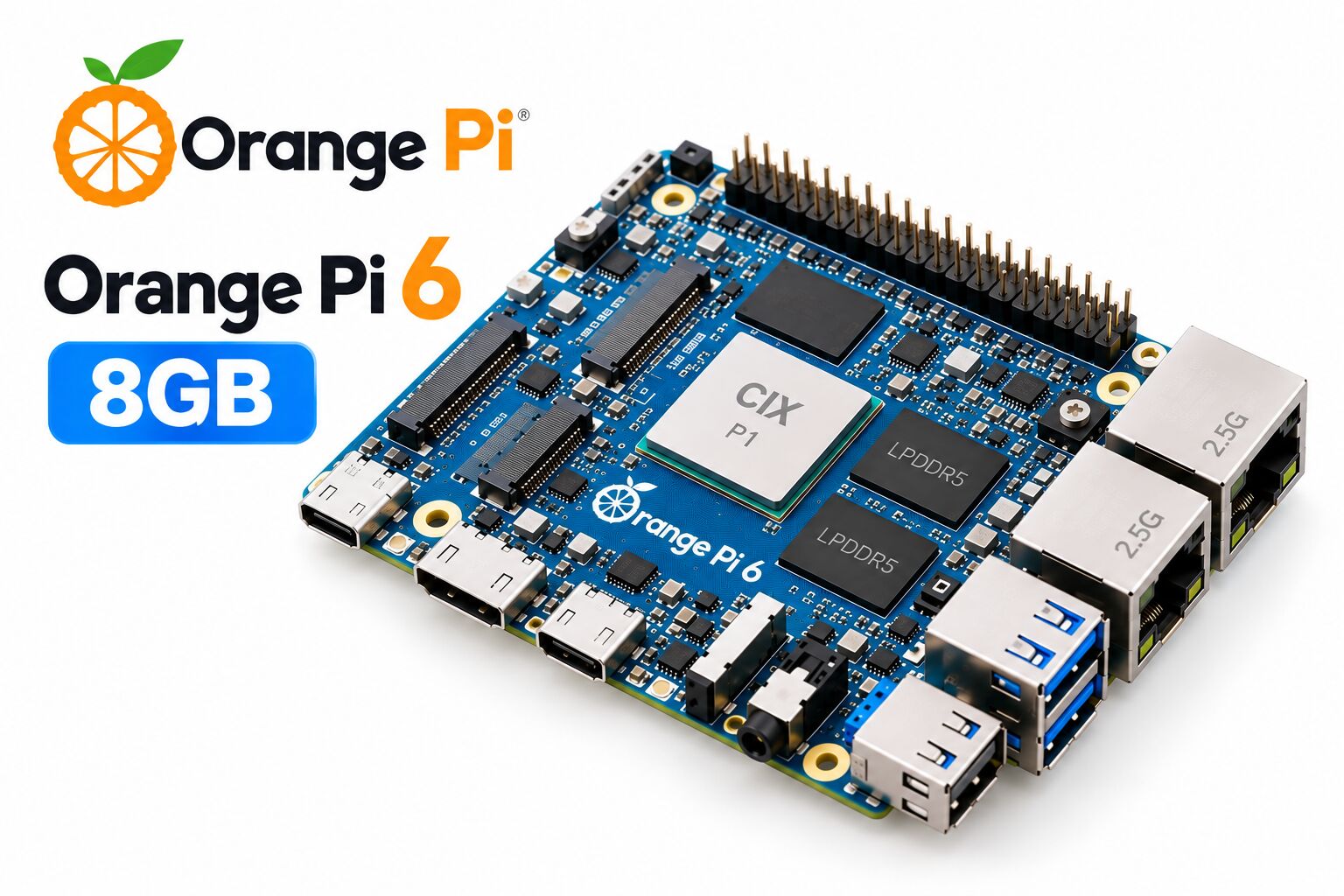
CPU: CIX P1 (CD8180) 2600 MHz | 12 Cores | ARMv9
RAM: 8192 MB LPDDR5
Ethernet Interfaces Qty: 2
Gigabit Ethernet: Yes
USB Ports Qty: 4
USB 3.0: Yes
Wi-Fi+BT: No
Wi-Fi 6: No
NVMe Port: Yes
The Orange Pi 6 8GB is a high-performance single-board computer built around the CIX P1 (CD8180) 12-core Arm processor. It combines 8GB of 128-bit LPDDR5 memory with an Arm Immortalis-G720 MC10 GPU, a dedicated NPU, dual 2.5GbE networking, and two PCIe 4.0 x4 M.2 slots for NVMe SSDs.
The 8GB version is the entry-level memory configuration for the Orange Pi 6 family, which is also offered with 16GB and 24GB of LPDDR5 memory.
With its 12-core CPU, fast memory, dual 2.5GbE ports and two NVMe interfaces, the Orange Pi 6 8GB can be used for Linux development, Docker, NAS projects, AI edge computing, home servers, networking and embedded applications.
Orange Pi 6 8GB Specifications
| Specification | Orange Pi 6 8GB |
|---|---|
| SoC | CIX P1 / CD8180 |
| CPU | 12-core Arm |
| CPU architecture | 4 × Cortex-A720 + 4 × Cortex-A720 + 4 × Cortex-A520 |
| CPU frequency | Up to 2.6 GHz |
| GPU | Arm Immortalis-G720 MC10 |
| GPU features | Vulkan 1.3, OpenGL ES 3.2, OpenCL 3.0, hardware ray tracing |
| NPU | Up to 28.8 TOPS |
| Combined AI compute | Up to 45 TOPS |
| RAM | 8GB LPDDR5 |
| Memory bus | 128-bit |
| Storage | microSD + 64Mbit SPI NAND |
| NVMe | 2 × M.2 M-Key PCIe 4.0 x4 |
| Ethernet | 2 × 2.5GbE |
| Wireless | Optional M.2 E-Key module |
| USB 3 | 2 × USB 3.2 Gen 2 Type-A |
| USB 2 | 2 × USB 2.0 Type-A |
| USB-C | 2 × full-function USB-C |
| HDMI | HDMI 2.0, up to 4K60 |
| DisplayPort | DisplayPort 1.4, up to 4K120 |
| GPIO | 40-pin |
| Camera | 2 × 4-lane MIPI CSI |
| Power | USB-C PD |
| Dimensions | 90 × 90 mm |
| Weight | Approximately 106 g |
The Orange Pi 6 uses the same CIX P1 platform across its memory variants; the primary difference between the 8GB, 16GB and 24GB versions is the amount of LPDDR5 memory.
CIX P1 12-Core Processor
The Orange Pi 6 8GB uses the CIX P1 (CD8180), a 12-core Arm processor manufactured using a 6nm process.
The CPU contains:
- 4 × Cortex-A720 performance cores
- 4 × Cortex-A720 cores
- 4 × Cortex-A520 efficiency cores
The published Orange Pi 6 specifications list frequencies of up to 2.6 GHz for the performance cores, 2.4 GHz for the second Cortex-A720 cluster and 1.8 GHz for the Cortex-A520 cores.
This configuration provides substantial CPU resources for multitasking, software development, servers and other demanding SBC workloads.
8GB LPDDR5 Memory
The Orange Pi 6 8GB includes 8GB of 128-bit LPDDR5 memory.
This provides considerably more memory than entry-level SBC configurations and gives the board enough capacity for many desktop, server and development workloads.
The 8GB configuration can be used for:
- Linux desktops
- Docker
- Web servers
- Databases
- NAS
- Home servers
- Development environments
- AI applications
- Edge computing
- Multimedia applications
The Orange Pi 6 is available with 8GB, 16GB and 24GB memory configurations.
Immortalis-G720 MC10 GPU
The CIX P1 integrates an Arm Immortalis-G720 MC10 GPU.
It supports:
- Vulkan 1.3
- OpenGL ES 3.2
- OpenCL 3.0
- Hardware ray tracing
This gives the Orange Pi 6 capabilities for graphics-intensive applications, Linux desktop environments, multimedia and GPU-accelerated workloads.
AI Acceleration
The Orange Pi 6 includes a dedicated NPU capable of up to 28.8 TOPS.
Orange Pi also specifies up to 45 TOPS of combined AI compute across the CPU, GPU and NPU.
The NPU supports formats including:
- INT4
- INT8
- INT16
- FP16
- BF16
- TF32
Potential applications include:
- Computer vision
- Object detection
- Image recognition
- AI inference
- Robotics
- Smart cameras
- Edge AI
- Industrial automation
Actual AI performance depends on the model, framework, drivers and software optimization.
Dual NVMe Storage
One of the most useful features of the Orange Pi 6 is its two M.2 M-Key slots.
Both interfaces support PCIe 4.0 x4, allowing the board to use two high-speed NVMe SSDs.
This makes the Orange Pi 6 8GB suitable for projects requiring fast local storage:
- NAS
- File servers
- Databases
- Docker storage
- Development environments
- Media servers
- AI datasets
- Local backups
The board also includes a microSD card slot and 64Mbit SPI NAND flash.
Dual 2.5GbE Ethernet
The Orange Pi 6 has two 2.5GbE Ethernet ports.
This is particularly useful for networking and storage applications where Gigabit Ethernet would become a limitation.
Potential applications include:
- NAS
- Router
- Firewall
- Network gateway
- Home lab
- Docker server
- File server
- High-speed backup server
The standard Orange Pi 6 uses dual 2.5GbE, while the larger Orange Pi 6 Plus uses dual 5GbE.
Optional Wi-Fi and Bluetooth
Wireless connectivity is provided through an M.2 E-Key interface for an optional module rather than being permanently integrated into the standard Orange Pi 6 configuration.
Compatible modules can provide Wi-Fi and Bluetooth connectivity. Current hardware information lists Wi-Fi 6 and Bluetooth 5.4 support through the optional module.
USB Connectivity
The Orange Pi 6 provides multiple USB interfaces.
The board includes:
- 2 × USB 3.2 Gen 2 Type-A
- 2 × USB 2.0 Type-A
- 2 × USB-C
The USB 3 interfaces provide high-speed connectivity for external storage and other peripherals.
Possible peripherals include:
- SSDs
- Hard drives
- Keyboards
- Mice
- Cameras
- Controllers
- USB adapters
- Development equipment
Display Outputs
The Orange Pi 6 provides several display interfaces.
HDMI 2.0
The HDMI output supports resolutions up to 4K at 60Hz.
DisplayPort 1.4
The DisplayPort interface supports up to 4K at 120Hz.
USB-C DisplayPort
The USB-C ports support DisplayPort Alt Mode up to 4K60.
eDP
An eDP interface is also available for compatible embedded displays.
This makes the Orange Pi 6 suitable for desktops, digital signage and embedded display projects.
Video Processing
The CIX P1 provides hardware video acceleration.
The Orange Pi 6 supports hardware decoding for formats including:
- AV1
- H.265
- H.264
- VP9
- VP8
- H.263
- MPEG-4
- MPEG-2
Video encoding supports H.265, H.264, VP9 and VP8. The published specifications list decoding up to 8K60 and encoding up to 8K30 for supported formats.
40-Pin GPIO
The Orange Pi 6 includes a 40-pin GPIO header.
The header provides interfaces such as:
- GPIO
- UART
- I²C
- SPI
- PWM
This makes the board suitable for hardware projects involving sensors, displays, robotics, automation and IoT devices.
Camera Interfaces
The Orange Pi 6 includes two 4-lane MIPI CSI interfaces.
These interfaces can connect compatible camera modules for applications such as:
- Computer vision
- AI cameras
- Robotics
- Surveillance
- Industrial imaging
- Image processing
The combination of the CSI interfaces and dedicated NPU provides a hardware foundation for edge-AI camera projects.
Orange Pi 6 8GB for Docker
The 8GB version provides enough memory for a broad range of containerized applications.
It can be used for:
- Web servers
- Databases
- Home automation
- Monitoring
- Development environments
- Media servers
- Self-hosted applications
- AI services
The two NVMe interfaces also provide fast storage for container images and application data.
Orange Pi 6 8GB as a NAS
The Orange Pi 6 is particularly interesting for NAS projects because it combines:
8GB RAM + 2 × NVMe PCIe 4.0 x4 + 2 × 2.5GbE
This allows you to build a compact storage server using two NVMe SSDs and high-speed network connectivity.
Possible applications include:
- File server
- Backup server
- Media storage
- Personal cloud
- Docker storage
- Development server
Actual NAS performance depends on the SSDs, filesystem, operating system, network equipment and NAS software.
Orange Pi 6 8GB for AI
The 8GB version includes the same CPU, GPU and NPU as the higher-memory Orange Pi 6 configurations.
Its hardware includes:
- 12-core CIX P1 processor
- Immortalis-G720 MC10 GPU
- 28.8 TOPS NPU
- Up to 45 TOPS combined AI compute
- 8GB LPDDR5
- Two NVMe interfaces
- Two 2.5GbE ports
- Two MIPI CSI interfaces
This provides a platform for edge-AI experiments, computer vision and local inference.
Operating Systems
The Orange Pi 6 is listed with support for:
- Debian
- Ubuntu
- Android
- Windows
- OpenHarmony
- ROS2
Software support can differ between operating systems, particularly for GPU acceleration, NPU functionality, video acceleration and peripheral drivers. Check the current software documentation before selecting an operating system for a specific project.
Orange Pi 6 8GB vs Orange Pi 6 16GB
The hardware is essentially the same between these two configurations.
| Feature | Orange Pi 6 8GB | Orange Pi 6 16GB |
|---|---|---|
| SoC | CIX P1 | CIX P1 |
| CPU | 12-core | 12-core |
| GPU | Immortalis-G720 MC10 | Immortalis-G720 MC10 |
| NPU | 28.8 TOPS | 28.8 TOPS |
| RAM | 8GB LPDDR5 | 16GB LPDDR5 |
| NVMe | 2 × PCIe 4.0 x4 | 2 × PCIe 4.0 x4 |
| Ethernet | 2 × 2.5GbE | 2 × 2.5GbE |
| GPIO | 40-pin | 40-pin |
| Dimensions | 90 × 90 mm | 90 × 90 mm |
The main difference is memory capacity. The 8GB version is appropriate for many server, development and SBC projects, while the 16GB version provides more memory for applications that need larger datasets or multiple memory-intensive services.
Orange Pi 6 8GB vs Orange Pi 6 Plus
| Feature | Orange Pi 6 8GB | Orange Pi 6 Plus |
|---|---|---|
| SoC | CIX P1 | CIX P1 |
| CPU | 12-core | 12-core |
| RAM | 8GB | 16GB+ |
| GPU | Immortalis-G720 MC10 | Immortalis-G720 MC10 |
| NPU | 28.8 TOPS | 28.8 TOPS |
| Ethernet | 2 × 2.5GbE | 2 × 5GbE |
| NVMe | 2 × PCIe 4.0 x4 | 2 × PCIe 4.0 x4 |
| Size | 90 × 90 mm | 115 × 100 mm |
The Orange Pi 6 is the smaller board and uses dual 2.5GbE. The Orange Pi 6 Plus is larger and provides dual 5GbE networking.
Dimensions
The Orange Pi 6 measures approximately:
90 × 90 mm
and weighs approximately 106 grams.
This makes it considerably more compact than the Orange Pi 6 Plus while retaining the same CIX P1 processor platform.
Orange Pi 6 8GB Specifications Summary
| Feature | Details |
|---|---|
| Product | Orange Pi 6 8GB |
| SoC | CIX P1 / CD8180 |
| CPU | 12-core Arm |
| CPU configuration | 4 × A720 + 4 × A720 + 4 × A520 |
| CPU frequency | Up to 2.6 GHz |
| GPU | Immortalis-G720 MC10 |
| NPU | 28.8 TOPS |
| Combined AI compute | Up to 45 TOPS |
| RAM | 8GB LPDDR5 |
| Storage | microSD + SPI NAND |
| NVMe | 2 × M.2 PCIe 4.0 x4 |
| Ethernet | 2 × 2.5GbE |
| Wi-Fi | Optional M.2 E-Key |
| Bluetooth | Optional M.2 E-Key |
| HDMI | Up to 4K60 |
| DisplayPort | Up to 4K120 |
| GPIO | 40-pin |
| Camera | 2 × 4-lane MIPI CSI |
| Power | USB-C PD |
| Dimensions | 90 × 90 mm |
| Weight | 106 g |
Frequently Asked Questions
How much RAM does the Orange Pi 6 8GB have?
The Orange Pi 6 8GB has 8GB of LPDDR5 memory using a 128-bit memory interface.
How many CPU cores does the Orange Pi 6 have?
The CIX P1 processor has 12 Arm CPU cores: four Cortex-A720 performance cores, four additional Cortex-A720 cores and four Cortex-A520 efficiency cores.
Does the Orange Pi 6 have an NPU?
Yes. The dedicated NPU provides up to 28.8 TOPS, with the platform specified at up to 45 TOPS of combined AI compute.
Does the Orange Pi 6 support NVMe?
Yes. It provides two M.2 M-Key slots supporting PCIe 4.0 x4 for NVMe SSDs.
Does the Orange Pi 6 have 2.5GbE?
Yes. It has two 2.5GbE Ethernet ports.
Does the Orange Pi 6 have built-in Wi-Fi?
Wireless connectivity is available through an optional M.2 E-Key module rather than being permanently integrated into the standard board.
Can the Orange Pi 6 8GB run Docker?
Yes. The 12-core processor, 8GB RAM and fast NVMe support make it suitable for Docker and other containerized applications.
Can the Orange Pi 6 8GB be used as a NAS?
Yes. Its two NVMe interfaces and dual 2.5GbE ports make it a suitable platform for a compact NAS or file server.
What operating systems work with the Orange Pi 6?
The platform is listed with Debian, Ubuntu, Android, Windows, OpenHarmony and ROS2 support, although feature and driver support varies by operating system.