CPU: Cortex-A78AE v8.2 64-bit 1700 MHz | 6 Cores | ARMv8
RAM: 8192 MB LPDDR5
Ethernet Interfaces Qty: 1
Gigabit Ethernet: Yes
USB Ports Qty: 4
USB 3.0: Yes
Wi-Fi+BT: Yes
Wi-Fi 6: No
NVMe Port: Yes
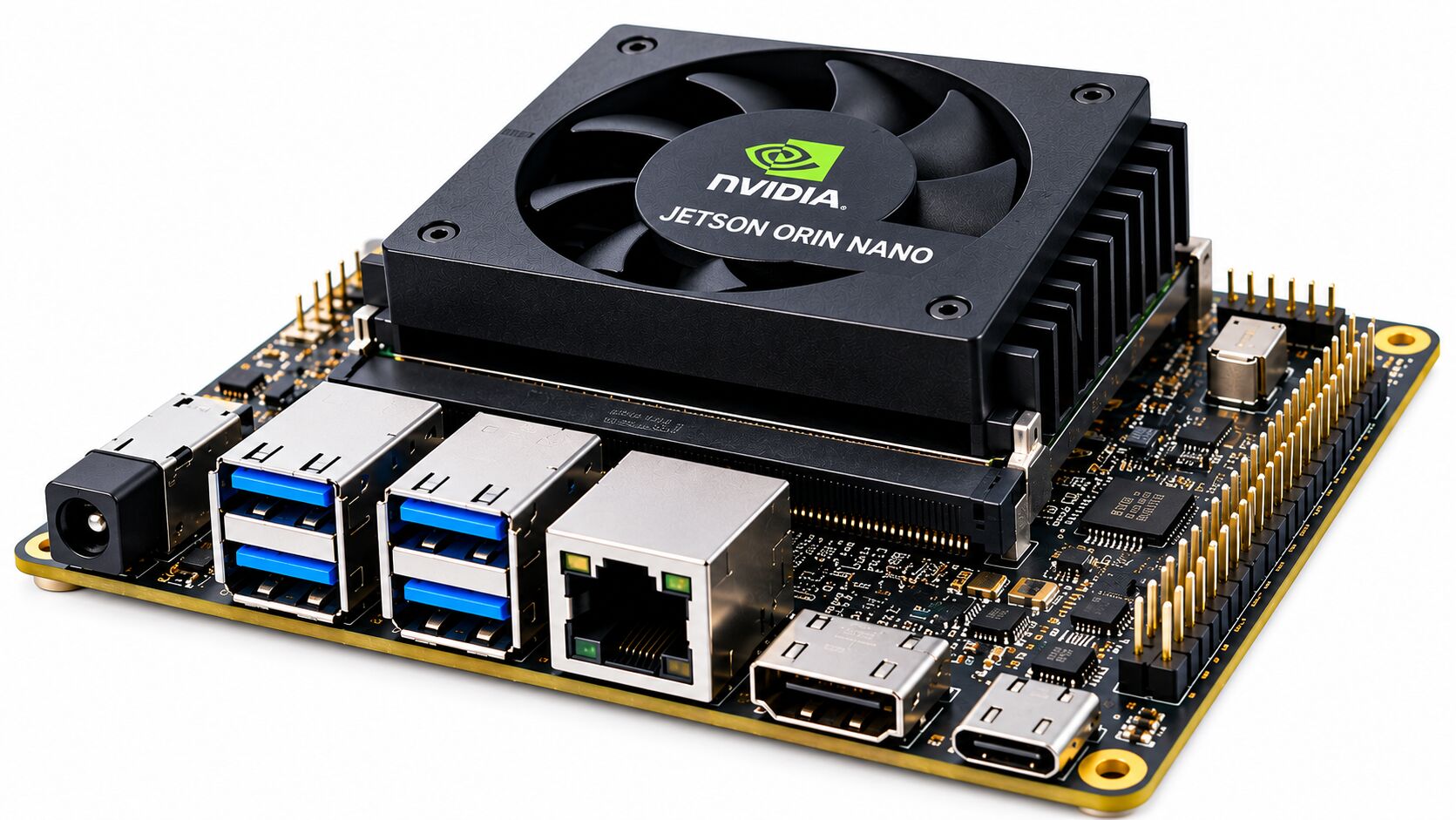
The NVIDIA Jetson Orin Nano Super Developer Kit is a compact single-board computer designed specifically for edge AI, computer vision, robotics, and generative AI applications. It combines a 6-core Arm CPU with an NVIDIA Ampere GPU featuring 1,024 CUDA cores and 32 Tensor Cores.
With up to 67 INT8 TOPS of AI performance, 8GB of LPDDR5 memory, and support for high-speed NVMe storage, the Jetson Orin Nano Super is considerably more focused on AI workloads than a conventional Raspberry Pi-class SBC. NVIDIA
It is particularly well suited for developers building AI-powered cameras, robotics projects, computer-vision systems, edge inference applications, and other workloads where GPU acceleration is important.
NVIDIA Jetson Orin Nano Super Specifications
| Specification | Jetson Orin Nano Super |
|---|---|
| CPU | 6-core Arm Cortex-A78AE v8.2 64-bit |
| CPU Frequency | Up to 1.7 GHz |
| GPU | NVIDIA Ampere |
| CUDA Cores | 1,024 |
| Tensor Cores | 32 |
| AI Performance | Up to 67 INT8 TOPS |
| Memory | 8GB LPDDR5 |
| Memory Interface | 128-bit |
| Memory Bandwidth | 102 GB/s |
| Storage | microSD + external NVMe |
| Power | 7W–25W |
| Architecture | ARM64 |
| Form Factor | Single-board computer / embedded developer kit |
The current Super configuration increases the GPU frequency and memory bandwidth compared with the original Jetson Orin Nano 8GB configuration. NVIDIA Developer
AI Performance
AI acceleration is the main reason to choose the Jetson Orin Nano Super over a conventional SBC.
The board provides an NVIDIA Ampere GPU with 1,024 CUDA cores and 32 Tensor Cores, allowing it to accelerate machine-learning inference and computer-vision workloads locally. NVIDIA rates the Super configuration at up to 67 INT8 TOPS. NVIDIA
This makes it suitable for workloads such as:
- Computer vision
- Object detection
- Image classification
- Generative AI
- Large language models
- Vision-language models
- Robotics
- AI cameras
- Edge inference
- Autonomous systems
- Real-time image processing
NVIDIA specifically highlights support for modern LLMs, VLMs, and vision transformers, including models with up to 8 billion parameters in appropriate configurations. NVIDIA Developer
CPU and GPU
The Jetson Orin Nano Super combines a 6-core Arm Cortex-A78AE CPU with an NVIDIA Ampere GPU.
The CPU provides the general-purpose processing required for the operating system, applications, networking, and data processing, while the GPU handles highly parallel workloads such as neural-network inference and computer vision.
The GPU includes:
- 1,024 CUDA cores
- 32 Tensor Cores
- NVIDIA Ampere architecture
This GPU architecture is one of the biggest differences between the Jetson Orin Nano Super and more general-purpose SBCs such as the Raspberry Pi 5. NVIDIA
8GB LPDDR5 Memory
The Jetson Orin Nano Super includes 8GB of 128-bit LPDDR5 memory with up to 102 GB/s of memory bandwidth.
Unlike many desktop systems, the Jetson uses shared system memory rather than a separate pool of VRAM attached to the GPU.
The high memory bandwidth is particularly useful for AI inference and computer-vision workloads where large amounts of data need to move between the CPU, GPU, and application.
Storage
The Jetson Orin Nano Super Developer Kit supports bootable storage through its SD card slot and also supports external NVMe storage.
For serious AI workloads, an NVMe SSD is generally preferable to a microSD card because it provides faster storage performance and better responsiveness for applications that frequently read and write large datasets.
The developer kit supports NVMe through its M.2 interface. NVIDIA
Connectivity and Expansion
The Jetson Orin Nano Developer Kit provides a substantial set of interfaces for an SBC of its size.
The original developer-kit carrier board includes:
- Gigabit Ethernet
- 4 × USB 3.2 Gen 2 Type-A
- USB-C for debug/device mode
- 2 × MIPI CSI-2 camera connectors
- M.2 Key-M NVMe interfaces
- M.2 Key-E wireless interface
- DisplayPort
- 40-pin expansion header
- Fan connector
- DC power input
The carrier board is designed for development with cameras, sensors, storage and other peripherals. NVIDIA Developer
Raspberry Pi-Style 40-Pin Header
The Jetson Orin Nano developer kit includes a 40-pin expansion header supporting interfaces such as:
- GPIO
- UART
- SPI
- I2C
- I2S
This makes the board useful for connecting sensors, displays, buttons, motors and other hardware used in robotics and embedded projects. NVIDIA Developer
However, compatibility with Raspberry Pi HATs should not be assumed simply because both boards use a 40-pin header. The electrical characteristics, software support, pin assignments and drivers can differ.
Camera and Computer Vision Projects
One of the strongest applications for the Jetson Orin Nano Super is computer vision.
The developer kit includes two MIPI CSI camera connectors, allowing compatible camera modules to be connected directly to the board. NVIDIA Developer
This makes the Jetson particularly interesting for projects involving:
- Object detection
- Security cameras
- Image recognition
- People counting
- Industrial inspection
- Robotics vision
- Autonomous vehicles
- AI-assisted photography
- Real-time video analytics
For these applications, the NVIDIA GPU provides a major advantage over SBCs that rely primarily on CPU processing.
Power Consumption
The Jetson Orin Nano Super supports configurable power modes from 7W to 25W. NVIDIA
This allows developers to balance performance and power consumption depending on the application.
A lower power mode can be useful for embedded systems where energy consumption is important, while higher power configurations provide additional performance for demanding AI workloads.
Actual system consumption depends on the workload, peripherals, storage, cooling, and selected power mode.
Cooling
The Jetson Orin Nano Super is designed for sustained computational workloads and uses active cooling in the developer kit.
This is important because AI inference can place considerably more sustained load on the GPU than typical desktop or lightweight SBC workloads.
For applications involving continuous AI inference, computer vision, or robotics, adequate cooling should be considered part of the system design.
Software and AI Ecosystem
The Jetson platform’s biggest advantage isn’t only its hardware. NVIDIA provides an extensive software ecosystem specifically designed for accelerated AI workloads.
The Jetson ecosystem includes technologies and frameworks such as:
- NVIDIA TensorRT
- TensorRT-LLM
- NVIDIA DeepStream
- NVIDIA Isaac
- NVIDIA Riva
- NVIDIA TAO Toolkit
- CUDA
- cuDNN
- OpenCV
- PyTorch
- TensorFlow
NVIDIA also highlights compatibility with tools and frameworks including Hugging Face Transformers, Ollama, llama.cpp, vLLM and MLC. NVIDIA Developer
This makes Jetson particularly attractive if your project requires NVIDIA’s CUDA and AI acceleration ecosystem.
What Can You Use the Jetson Orin Nano Super For?
The board is particularly well suited to applications where GPU-accelerated AI is more important than low-cost general-purpose computing.
Edge AI
Run AI models locally without sending every image or piece of data to a cloud service.
Computer Vision
Build systems that analyze camera feeds in real time.
Robotics
The Jetson platform is designed for robotics applications and integrates with NVIDIA’s robotics software ecosystem.
Generative AI
The Super update significantly improves the board’s ability to run modern generative-AI models locally. NVIDIA
AI Security Cameras
Combine cameras with object detection, classification, and other computer-vision models.
AI Development
Use the Jetson as a compact development platform for creating and testing edge-AI applications before deploying them to embedded hardware.
NVIDIA Jetson Orin Nano Super vs Raspberry Pi 5
The Jetson Orin Nano Super and Raspberry Pi 5 target somewhat different audiences.
| Feature | Jetson Orin Nano Super | Raspberry Pi 5 |
|---|---|---|
| Primary focus | Edge AI | General-purpose computing |
| CPU | 6-core Cortex-A78AE | 4-core Cortex-A76 |
| GPU | NVIDIA Ampere | VideoCore VII |
| CUDA | Yes | No |
| Tensor Cores | 32 | No |
| AI Performance | Up to 67 INT8 TOPS | Not directly comparable |
| Memory | 8GB LPDDR5 | 4GB / 8GB / 16GB variants |
| AI ecosystem | NVIDIA CUDA / TensorRT | General Linux ecosystem |
| Camera | MIPI CSI | MIPI CSI |
| GPIO | 40-pin | 40-pin |
| NVMe | Supported | Supported with compatible hardware |
| Best suited for | AI, vision, robotics | Servers, projects, general computing |
The important distinction is that these boards aren’t simply competing on CPU speed. The Jetson Orin Nano Super is built around GPU-accelerated AI, while the Raspberry Pi 5 is a much more general-purpose SBC.
Is the Jetson Orin Nano Super a Single Board Computer?
Yes, it fits naturally into the single-board computer ecosystem, although its design philosophy is different from mainstream SBCs.
A Raspberry Pi can be used for everything from a Linux desktop to a home server, NAS, VPN server, Docker host, or automation controller.
The Jetson Orin Nano Super is much more specialized. Its major selling point is the combination of ARM computing and NVIDIA GPU acceleration for AI and edge-computing applications.
Who Should Buy the Jetson Orin Nano Super?
The Jetson Orin Nano Super makes the most sense for:
- AI developers
- Computer-vision developers
- Robotics enthusiasts
- Machine-learning students
- Edge-AI researchers
- Developers working with CUDA
- AI camera projects
- Autonomous robotics projects
- Generative-AI experimentation
It is less compelling if you simply need an inexpensive Linux computer, media server, Pi-hole server, Docker host, or basic home server.
For those applications, a Raspberry Pi or another general-purpose SBC may provide a simpler and more economical platform.
Jetson Orin Nano Super for AI Projects
The NVIDIA Jetson Orin Nano Super stands out from conventional SBCs because it combines a compact ARM platform with a powerful NVIDIA GPU and dedicated Tensor Cores.
Its 67 INT8 TOPS, 8GB LPDDR5 memory, CUDA support, and extensive AI software ecosystem make it one of the more capable compact platforms for edge AI and computer vision. NVIDIA
For developers interested specifically in AI, robotics, computer vision, and local inference, the Jetson Orin Nano Super is a very different proposition from a Raspberry Pi. Instead of being a general-purpose SBC that happens to support AI workloads, it is an SBC-class platform designed around accelerated AI computing.