CPU: Intel® Celeron® N5105 2900 MHz | 4 Cores | x86
RAM: 8192 MB LPDDR4
Ethernet Interfaces Qty: 1
Gigabit Ethernet: Yes
USB Ports Qty: 4
USB 3.0: Yes
Wi-Fi+BT: Yes
Wi-Fi 6: No
NVMe Port: No
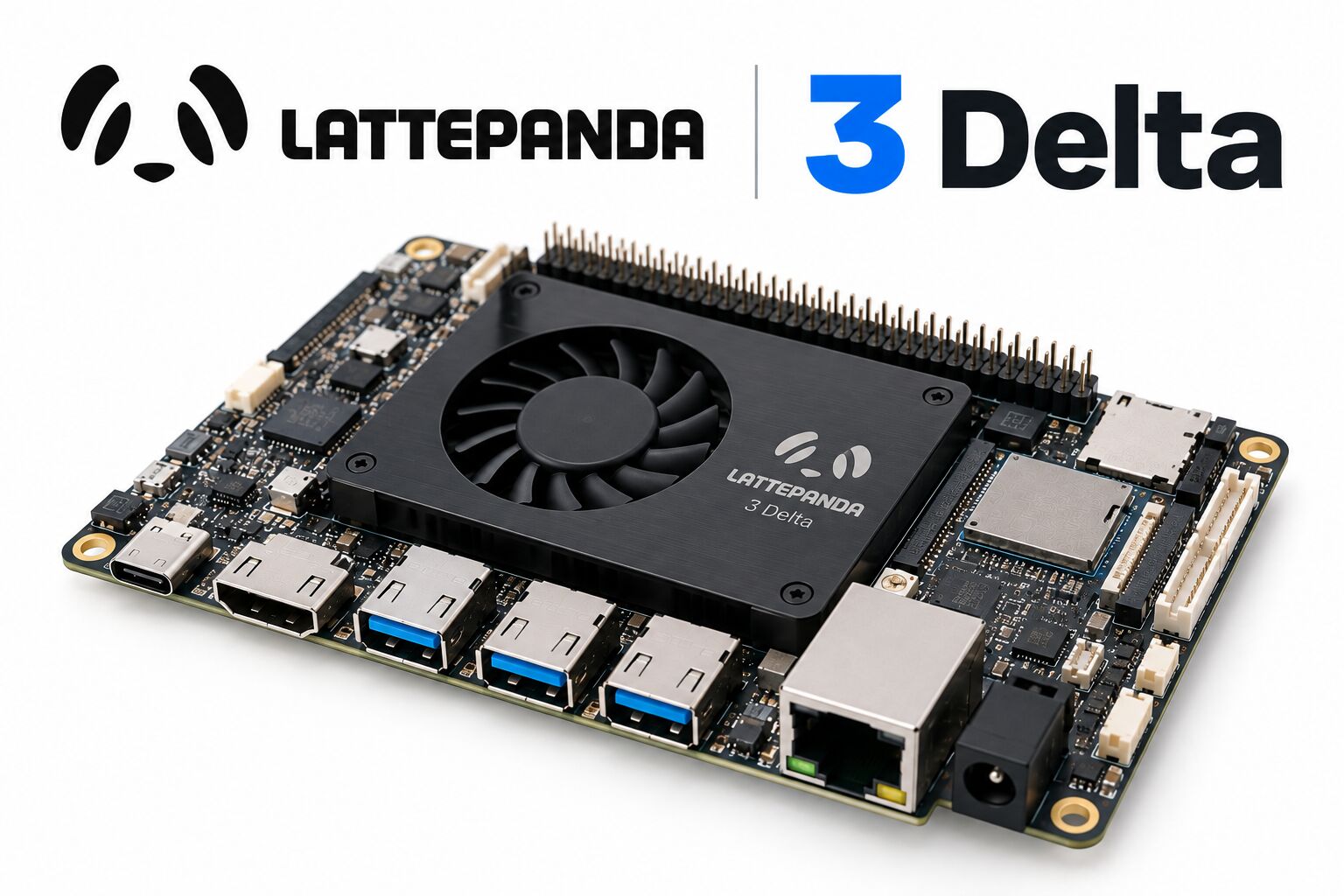
The LattePanda 3 Delta is a compact x86 single-board computer built around the Intel Celeron N5105 processor. Unlike ARM-based SBCs, it uses an Intel 64-bit platform and can run Windows as well as Linux, making it suitable for desktop computing, development, industrial automation, edge computing and embedded projects.
The board combines a quad-core Intel processor, 8GB of LPDDR4 memory, 64GB eMMC storage, Wi-Fi 6, Bluetooth 5.2, 2.5Gb Ethernet, NVMe support and an Arduino-compatible ATmega32U4 co-processor.
Its compact 125 × 78 × 16 mm design also includes extensive GPIO and expansion interfaces, giving the LattePanda 3 Delta characteristics of both a conventional computer and a development board.
LattePanda 3 Delta Specifications
| Specification | LattePanda 3 Delta |
|---|---|
| Processor | Intel Celeron N5105 |
| CPU | 4 cores / 4 threads |
| CPU frequency | 2.0–2.9GHz |
| GPU | Intel UHD Graphics |
| GPU frequency | 450–800MHz |
| RAM | 8GB LPDDR4 |
| RAM speed | 2933MHz |
| Storage | 64GB eMMC 5.1 |
| Ethernet | 2.5Gb Ethernet |
| Wi-Fi | Wi-Fi 6 |
| Bluetooth | Bluetooth 5.2 |
| USB | 1 × USB 3.2 Gen 2, 2 × USB 3.2 Gen 1 |
| USB-C | USB-C with USB 2.0 / DisplayPort / PD |
| NVMe | M.2 M-Key PCIe 3.0 x2 |
| Expansion | M.2 B-Key |
| SIM | Micro-SIM |
| Display | HDMI 2.0b, DisplayPort 1.4, eDP |
| HDMI resolution | Up to 4096 × 2160 @ 60Hz |
| Co-processor | ATmega32U4 |
| GPIO | Analog and digital I/O, PWM, UART, I²C, SPI |
| Audio | Microphone/headphone combo |
| TPM | TPM 2.0 |
| RTC | CR927 |
| Power | 12V DC / USB-C PD |
| Dimensions | 125 × 78 × 16mm |
| Operating systems | Windows 10, Windows 11, Linux |
Intel Celeron N5105 Processor
The LattePanda 3 Delta uses the Intel Celeron N5105, a quad-core, four-thread processor from Intel’s Jasper Lake family.
The processor operates from 2.0GHz to 2.9GHz and provides substantially more x86 compatibility than many ARM-based single-board computers.
The x86 architecture makes the LattePanda 3 Delta particularly interesting for applications where compatibility with traditional PC software is important.
Potential applications include:
- Windows applications
- Linux desktop computing
- Development environments
- Industrial software
- Edge computing
- Web applications
- Automation
- Lightweight servers
- Kiosk systems
Intel UHD Graphics
The integrated Intel UHD Graphics GPU operates at approximately 450–800MHz on the LattePanda 3 Delta.
The integrated graphics processor can handle common desktop and multimedia workloads and supports the board’s high-resolution display interfaces.
The LattePanda 3 Delta can drive displays through:
- HDMI 2.0b
- DisplayPort 1.4 through USB-C
- eDP
The official specifications support HDMI and DisplayPort resolutions up to 4096 × 2160 at 60Hz, while the eDP interface is intended for compatible embedded displays.
8GB LPDDR4 Memory
The LattePanda 3 Delta includes 8GB of LPDDR4 memory running at 2933MHz.
The RAM is integrated into the board rather than being user-upgradable.
The 8GB capacity provides enough memory for applications such as:
- Windows
- Linux
- Web browsing
- Programming
- Development environments
- Docker
- Home servers
- Industrial applications
- Edge computing
For an x86 SBC, the 8GB configuration also makes the board more practical as a compact desktop computer than many lower-memory development boards.
64GB eMMC Storage
The LattePanda 3 Delta includes 64GB of eMMC 5.1 storage.
This provides onboard storage for an operating system and applications without requiring a separate storage device.
The built-in eMMC can be supplemented with:
- NVMe SSD
- SATA storage
- microSD storage
This makes it possible to configure the board with fast primary storage while retaining the onboard eMMC for another operating system or recovery environment.
NVMe SSD Support
One of the most useful expansion features is the M.2 M-Key slot.
The M-Key interface uses PCIe 3.0 x2 and supports NVMe SSDs.
An NVMe SSD can provide substantially more storage than the onboard eMMC and is useful for:
- Linux installations
- Windows installations
- Docker
- Databases
- File servers
- Development
- Virtual machines
- Media libraries
The LattePanda 3 Delta can therefore be configured as a compact x86 server with NVMe storage.
M.2 B-Key Expansion
The board also includes an M.2 B-Key slot.
This interface supports combinations of:
- SATA
- USB 2.0
- USB 3.0
- SIM connectivity
- Optional PCIe support
The slot can be used with compatible cellular modules and other expansion hardware.
This makes the LattePanda 3 Delta useful for connected embedded systems where Wi-Fi alone isn’t sufficient.
Wi-Fi 6
The LattePanda 3 Delta includes Intel Wi-Fi 6 supporting 2.4GHz and 5GHz networks.
Wi-Fi 6 is useful for:
- Wireless servers
- IoT gateways
- Industrial systems
- Smart-home projects
- Edge computing
- Development systems
The board’s wireless networking complements its wired Ethernet connection.
Bluetooth 5.2
Bluetooth 5.2 is also integrated.
This allows the LattePanda 3 Delta to communicate with compatible:
- Keyboards
- Mice
- Controllers
- Sensors
- IoT devices
- Bluetooth peripherals
2.5Gb Ethernet
The LattePanda 3 Delta provides 2.5 Gigabit Ethernet for high-speed wired networking. The manufacturer’s current product specification lists a 2.5Gb Ethernet interface.
This is particularly useful when the board is configured as:
- A home server
- NAS
- Docker host
- Media server
- Development server
- Network appliance
A 2.5Gb connection also pairs well with an NVMe SSD when transferring files across a compatible local network.
USB Ports
The LattePanda 3 Delta includes several USB interfaces:
- 1 × USB 3.2 Gen 2 Type-A
- 2 × USB 3.2 Gen 1 Type-A
- 1 × USB Type-C
- USB 2.0 through the expansion header
The USB 3.2 Gen 2 port supports higher transfer speeds than the Gen 1 ports.
USB can be used for:
- External SSDs
- Hard drives
- Keyboards
- Mice
- Cameras
- Game controllers
- USB adapters
- Development peripherals
USB-C DisplayPort
The USB-C port provides more than data connectivity.
It supports:
- USB
- DisplayPort 1.4
- Power Delivery
This allows the port to be used for compatible displays as well as peripherals and power.
HDMI 2.0b
The LattePanda 3 Delta includes an HDMI 2.0b output.
It supports resolutions up to 4096 × 2160 at 60Hz, including HDR support according to LattePanda’s specifications.
The HDMI output makes the board suitable for:
- Desktop computers
- Digital signage
- Media systems
- Kiosks
- Embedded displays
- Development systems
Three-Way Display Support
The board supports multiple display interfaces:
- HDMI 2.0b
- DisplayPort 1.4 through USB-C
- eDP
LattePanda describes the board as supporting up to three-way video output.
This can be useful for:
- Multi-monitor workstations
- Digital signage
- Control panels
- Industrial interfaces
- Embedded displays
eDP Display Support
The LattePanda 3 Delta includes a 30-pin eDP interface.
The interface is designed for compatible embedded displays and can support touch displays. LattePanda specifies eDP displays up to 1920 × 1080 for this interface.
This makes it possible to build custom systems such as:
- Portable computers
- Touchscreen terminals
- Industrial control panels
- Kiosks
- Embedded dashboards
ATmega32U4 Co-Processor
One of the defining features of the LattePanda 3 Delta is its Microchip ATmega32U4 co-processor.
The ATmega32U4 is used to provide Arduino-compatible hardware control capabilities alongside the Intel computer.
This allows the board to combine conventional PC computing with microcontroller functionality.
Projects can therefore use the Intel processor for tasks such as:
- Windows applications
- Linux
- Python
- Web applications
- AI processing
while the ATmega32U4 handles hardware interfaces and real-time control.
GPIO and Arduino Interfaces
The LattePanda 3 Delta provides extensive hardware interfaces through its Arduino-compatible expansion headers.
The available interfaces include:
- Up to 12 analog inputs
- Up to 23 digital inputs/outputs
- Up to 7 PWM outputs
- UART
- I²C
- SPI
- RS232
- 5V output
- 3.3V output
This makes the board particularly well suited to hardware projects.
Potential applications include:
- Robotics
- Sensors
- Home automation
- Industrial controls
- Smart devices
- Interactive installations
- Educational projects
RS232 Support
The board includes a dedicated 4-pin RS232 header.
RS232 remains useful in industrial and embedded environments where equipment communicates through serial connections.
Possible applications include:
- Industrial controllers
- Automation equipment
- Serial devices
- Laboratory equipment
- Legacy hardware
Audio
The LattePanda 3 Delta includes a combined microphone and headphone connector.
This provides basic analog audio connectivity without requiring a USB sound card.
The board can therefore be used for:
- Multimedia systems
- Voice applications
- Kiosks
- Interactive installations
- Desktop computing
TPM 2.0
The LattePanda 3 Delta includes a TPM 2.0 security module.
TPM functionality can be useful for supported operating-system security features and device-management applications.
This is particularly relevant when running Windows or deploying the board in managed environments.
Watchdog Timer
A hardware watchdog timer is available on the LattePanda 3 Delta.
A watchdog can automatically restart a system if software becomes unresponsive.
This is useful for unattended systems such as:
- Industrial computers
- Digital signage
- Kiosks
- Remote systems
- Edge devices
- Home automation controllers
LattePanda also lists automatic power-on as one of the board’s supported features.
Automatic Power-On
The automatic power-on function allows the board to start when power is supplied without requiring a manual power-button press.
This is particularly useful for systems that need to operate automatically after a power interruption.
Examples include:
- Servers
- Kiosks
- Digital signage
- Industrial equipment
- Remote monitoring systems
RTC
The board includes an RTC using a CR927 3V battery.
The real-time clock allows the system to maintain time when powered off.
This can be useful for:
- Scheduled tasks
- Industrial automation
- Data logging
- Embedded systems
- Server applications
Power Requirements
The LattePanda 3 Delta supports two primary power methods:
- 12V DC input
- USB-C Power Delivery
LattePanda’s documentation specifies an acceptable input range of 11V to 15V and recommends a power supply capable of at least 24W. A 12V/2A supply is recommended for the DC input.
When using USB-C PD, the power adapter should support an appropriate voltage and sufficient power.
Using an inadequate power supply can result in instability, particularly when using additional peripherals or high-performance storage.
Cooling
The LattePanda 3 Delta includes an active cooling solution designed to keep the Intel processor operating under sustained workloads.
The manufacturer describes a redesigned cooling fan and a larger cooling area compared with the previous generation.
Active cooling is useful for workloads such as:
- Compiling software
- Windows applications
- Docker
- Edge computing
- Video processing
- Long-running server workloads
Windows Support
One of the major advantages of the LattePanda 3 Delta is its x86 architecture and Windows compatibility.
The board supports:
- Windows 10
- Windows 11
The manufacturer also offered configurations with Windows licenses, depending on the specific product model.
Windows compatibility makes the LattePanda 3 Delta different from many ARM-based SBCs.
It can be useful for applications that require conventional Windows software or drivers.
Linux Support
The LattePanda 3 Delta also supports Linux.
LattePanda lists Linux among the compatible operating systems for the board.
Linux allows the board to be used for:
- Ubuntu
- Development
- Docker
- Web servers
- Home servers
- Programming
- Edge computing
- Embedded applications
LattePanda 3 Delta for Docker
The Intel x86-64 architecture makes the LattePanda 3 Delta an interesting option for Docker users.
Compared with ARM-based SBCs, an x86 platform can simplify compatibility with software distributed primarily as x86-64 container images.
The 8GB RAM configuration can support multiple lightweight containers.
Potential applications include:
- Nginx
- Databases
- Home automation
- Monitoring
- Web applications
- Development environments
- Self-hosted services
An NVMe SSD can also be installed through the M.2 M-Key interface for container storage.
LattePanda 3 Delta as a Home Server
The combination of an Intel processor, 8GB RAM, 2.5Gb Ethernet and NVMe support makes the LattePanda 3 Delta suitable for compact server projects.
It can be configured as:
- Docker server
- Web server
- File server
- Home automation server
- Development server
- Monitoring server
- Media server
Its x86 architecture can also provide access to software that may not have ARM builds.
LattePanda 3 Delta for Industrial Applications
The board’s combination of x86 computing and microcontroller interfaces makes it particularly interesting for industrial applications.
Features such as:
- RS232
- GPIO
- PWM
- UART
- I²C
- SPI
- Watchdog
- Automatic power-on
- TPM 2.0
allow the board to interact with physical equipment while running a full operating system.
Possible applications include:
- Industrial control
- Machine interfaces
- Monitoring systems
- Automation
- Smart factories
- Edge computing
LattePanda 3 Delta for Robotics
The ATmega32U4 and Intel processor combination is also useful for robotics.
The Intel processor can handle higher-level tasks such as:
- Computer vision
- Python
- Linux
- Web interfaces
- Data processing
while the microcontroller can handle lower-level hardware control.
This architecture can be useful for:
- Autonomous robots
- Robotic arms
- Mobile robots
- Sensor platforms
- Educational robots
LattePanda 3 Delta Dimensions
The board measures approximately:
125 × 78 × 16mm
Its thin form factor makes it suitable for embedded applications where a conventional mini PC would be too large.
The compact design also makes it possible to integrate the board into custom enclosures and portable projects.
LattePanda 3 Delta Product Summary
| Feature | Details |
|---|---|
| Product | LattePanda 3 Delta |
| CPU | Intel Celeron N5105 |
| CPU | 4 cores / 4 threads |
| CPU frequency | 2.0–2.9GHz |
| GPU | Intel UHD Graphics |
| RAM | 8GB LPDDR4 2933MHz |
| Storage | 64GB eMMC 5.1 |
| NVMe | M.2 M-Key PCIe 3.0 x2 |
| Expansion | M.2 B-Key |
| Ethernet | 2.5Gb Ethernet |
| Wi-Fi | Wi-Fi 6 |
| Bluetooth | 5.2 |
| HDMI | HDMI 2.0b |
| DisplayPort | DP 1.4 via USB-C |
| eDP | 30-pin |
| USB | USB 3.2 Gen 2 + 2 × USB 3.2 Gen 1 |
| Co-processor | ATmega32U4 |
| GPIO | Analog, digital, PWM, UART, I²C, SPI |
| RS232 | Yes |
| TPM | 2.0 |
| RTC | CR927 |
| Operating systems | Windows 10, Windows 11, Linux |
| Power | 12V DC / USB-C PD |
| Dimensions | 125 × 78 × 16mm |
Frequently Asked Questions
What processor does the LattePanda 3 Delta use?
It uses the Intel Celeron N5105, a quad-core, four-thread processor running from 2.0GHz to 2.9GHz.
How much RAM does the LattePanda 3 Delta have?
The LattePanda 3 Delta has 8GB of LPDDR4 RAM running at 2933MHz.
How much storage does it have?
The board includes 64GB of eMMC 5.1 storage.
Does the LattePanda 3 Delta support NVMe?
Yes. It has an M.2 M-Key PCIe 3.0 x2 interface for NVMe SSDs.
Does it run Windows?
Yes. The LattePanda 3 Delta supports Windows 10 and Windows 11.
Does it run Linux?
Yes. Linux is also supported.
Does the LattePanda 3 Delta have Wi-Fi?
Yes. It includes Wi-Fi 6 supporting 2.4GHz and 5GHz networks.
Does it have Bluetooth?
Yes. The board includes Bluetooth 5.2.
Does it have Ethernet?
Yes. The current LattePanda specifications list 2.5 Gigabit Ethernet.
Does it have an Arduino controller?
Yes. The board includes a Microchip ATmega32U4 co-processor and Arduino-compatible interfaces.
Does it have GPIO?
Yes. The board provides analog inputs, digital I/O, PWM, UART, I²C and SPI interfaces through its expansion headers.
Does it support multiple displays?
Yes. It provides HDMI 2.0b, DisplayPort 1.4 through USB-C and an eDP interface, allowing up to three display outputs in supported configurations.
Can the LattePanda 3 Delta run Docker?
Yes. Its x86-64 platform and 8GB of RAM make it suitable for many Docker and self-hosted applications.
What power supply does it need?
The board accepts 11–15V input, with LattePanda recommending at least 24W. A 12V/2A power supply is recommended when using the DC input.