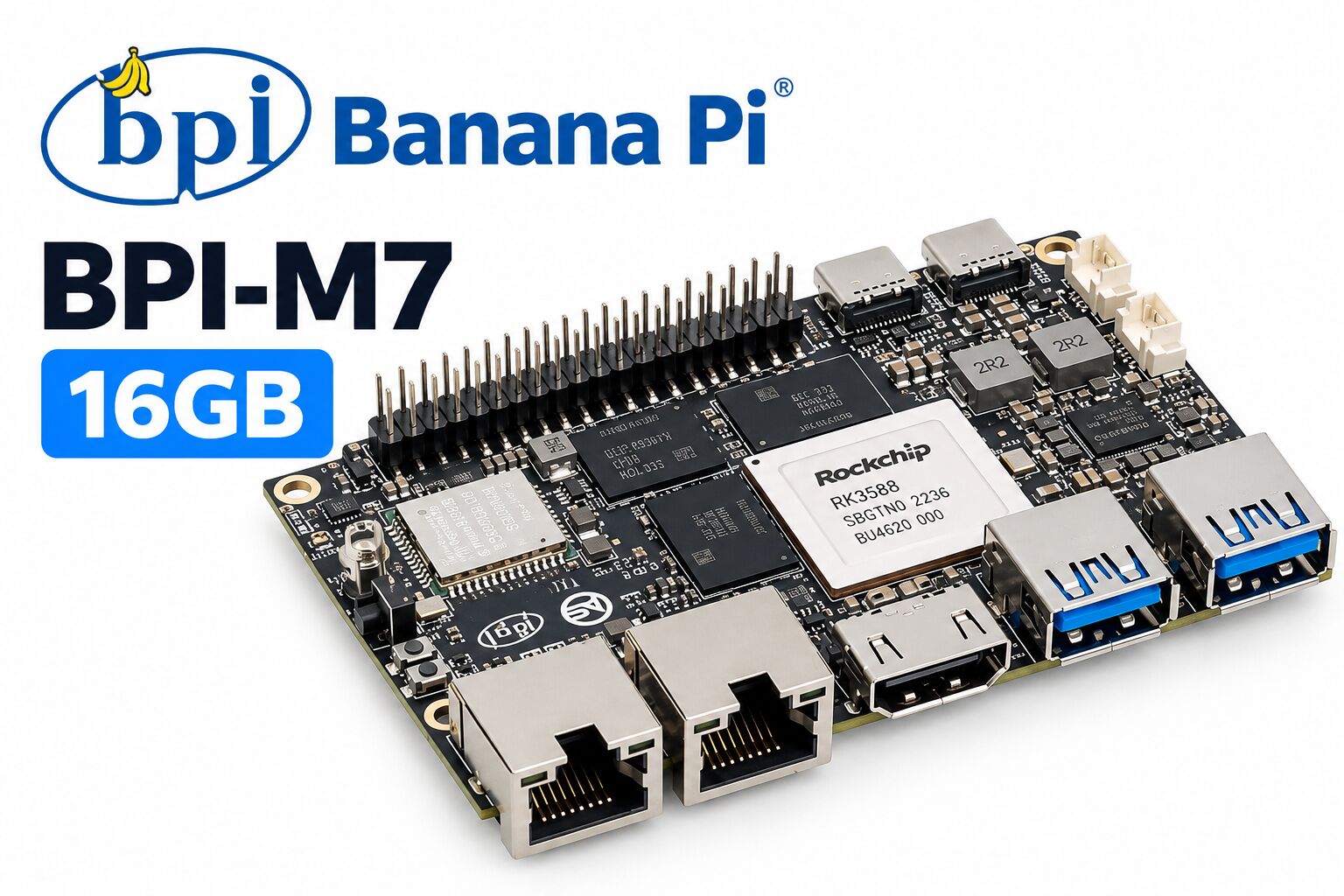
CPU: Rockchip RK3588 2400 MHz | 8 Cores | ARMv8
RAM: 16384 MB LPDDR4
Ethernet Interfaces Qty: 2
Gigabit Ethernet: Yes
USB Ports Qty: 4
USB 3.0: Yes
Wi-Fi+BT: Yes
Wi-Fi 6: Yes
NVMe Port: Yes
The Banana Pi BPI-M7 16GB is a high-performance single board computer built around the Rockchip RK3588. It combines an octa-core ARM processor, 16GB of LPDDR4/LPDDR4X memory, dual 2.5GbE networking, Wi-Fi 6, NVMe support through PCIe 3.0 x4, an integrated 6-TOPS NPU, and 8K video capabilities.
The 16GB version is particularly suited to demanding workloads such as Docker, home servers, NAS projects, edge computing, AI applications, development environments, and multimedia systems. Banana Pi’s public-sale configuration pairs the 16GB version with 128GB of eMMC storage.
Banana Pi BPI-M7 16GB Specifications
| Specification | Banana Pi BPI-M7 16GB |
|---|---|
| SoC | Rockchip RK3588 |
| CPU | 4× Cortex-A76 @ 2.4GHz + 4× Cortex-A55 @ 1.8GHz |
| CPU Architecture | 64-bit ARM |
| Manufacturing Process | 8nm |
| GPU | ARM Mali-G610 MP4 |
| NPU | 6 TOPS @ INT8 |
| RAM | 16GB LPDDR4/LPDDR4X |
| eMMC | 128GB on 16GB public-sale configuration |
| Storage Expansion | MicroSD |
| NVMe | M.2 M-Key PCIe 3.0 x4 |
| Ethernet | 2× 2.5GbE |
| Wi-Fi | Wi-Fi 6 |
| Bluetooth | Bluetooth 5.x |
| HDMI | HDMI 2.1, up to 8K@60Hz |
| DisplayPort | USB-C DP 1.4, up to 8K@30Hz |
| MIPI DSI | Up to 4K@60Hz |
| Camera | 2× 2-lane MIPI CSI |
| USB | USB 3.x, USB-C, USB 2.0 |
| GPIO | 40-pin |
| Power | USB-C PD 2.0 |
| Dimensions | 92 × 62 mm |
| Operating Temperature | 0°C–80°C |
Specifications are based primarily on Banana Pi’s official product documentation and wiki.
Rockchip RK3588 Processor
The BPI-M7 uses the Rockchip RK3588, an octa-core ARM processor with:
- 4× Cortex-A76 cores up to 2.4GHz
- 4× Cortex-A55 cores up to 1.8GHz
- 64-bit ARM architecture
- 8nm manufacturing process
The combination of high-performance Cortex-A76 cores and efficient Cortex-A55 cores makes the BPI-M7 suitable for workloads considerably more demanding than typical entry-level SBC projects.
16GB LPDDR4/LPDDR4X RAM
The 16GB memory configuration gives the BPI-M7 plenty of memory for applications that benefit from running multiple services simultaneously.
This makes the board interesting for:
- Docker containers
- Virtualization experiments
- Development environments
- Databases
- Home servers
- NAS applications
- AI and edge computing
- Web servers
- Network services
Banana Pi officially lists 8GB, 16GB and 32GB memory configurations for the BPI-M7.
128GB eMMC Storage
The public-sale 16GB configuration is paired with 128GB of eMMC storage, providing significantly more integrated storage than a basic microSD-only SBC.
The BPI-M7 also supports microSD expansion, while its M.2 M-Key interface can be used with an NVMe SSD. Banana Pi specifies PCIe 3.0 with four lanes and support for 2230, 2242, 2260 and 2280 M.2 drives.
NVMe SSD Support
One of the most useful features for a server build is the integrated M.2 M-Key PCIe 3.0 x4 interface.
It supports several common M.2 SSD sizes:
- 2230
- 2242
- 2260
- 2280
For applications involving databases, Docker volumes, NAS storage or large media libraries, an NVMe SSD can provide substantially faster storage than relying exclusively on a microSD card.
Dual 2.5GbE Networking
The BPI-M7 includes two 2.5 Gigabit Ethernet ports.
This is particularly useful for:
- NAS servers
- Routers
- Network appliances
- Docker servers
- Home labs
- File servers
- Virtualization experiments
- Network monitoring
Having two high-speed Ethernet ports also gives the board more flexibility for network-oriented projects than SBCs equipped with a single Gigabit Ethernet port.
Wi-Fi 6 and Bluetooth
Wireless connectivity is integrated into the board, with support for Wi-Fi 6 and Bluetooth 5.x. Banana Pi’s current product page identifies the wireless platform as supporting IEEE 802.11a/b/g/n/ac/ax.
8K Video Support
The RK3588 provides extensive video capabilities.
The BPI-M7 supports hardware decoding of formats including:
- H.265
- VP9
- AVS2
- H.264
- AV1
- MPEG-2
- MPEG-1
- VC-1
- VP8
The platform supports decoding up to 8K60 for several codecs and hardware encoding up to 8K30 for H.265/H.264.
Multiple Display Outputs
The BPI-M7 can drive multiple displays using several interfaces.
HDMI 2.1
The full-size HDMI interface supports resolutions up to:
8K @ 60Hz
USB-C DisplayPort
The USB-C display interface supports DisplayPort 1.4 with output up to:
8K @ 30Hz
MIPI DSI
The board also provides a MIPI DSI interface supporting up to:
4K @ 60Hz
This makes the BPI-M7 suitable for desktop, digital signage, embedded display and multimedia applications.
AI and NPU
The RK3588 includes a dedicated 6 TOPS NPU for AI workloads.
The NPU supports INT4, INT8 and INT16 mixed computing and frameworks including:
- TensorFlow
- PyTorch
- Caffe
- TFLite
- ONNX
- Android NN
This gives the BPI-M7 hardware acceleration capabilities for supported edge-AI workloads without relying entirely on the CPU.
Camera Support
The BPI-M7 includes two 2-lane MIPI CSI camera interfaces.
The integrated ISP supports cameras up to 48MP and includes HDR and 3D noise reduction capabilities.
This opens up applications such as:
- Security cameras
- Computer vision
- AI cameras
- Edge-AI projects
- Robotics
- Industrial monitoring
USB Connectivity
The board provides several USB interfaces, including USB 3.x, USB-C and USB 2.0.
The official hardware documentation specifies:
- 1× USB 3.0 / USB 3.1 Gen 1, up to 5Gbps
- 1× USB-C 3.1 with DP 1.4/OTG
- 1× USB 2.0
Banana Pi’s product overview also describes the board as having two USB 3.0 interfaces, so the detailed hardware table should be used when documenting the exact physical port configuration.
40-Pin GPIO Header
The BPI-M7 provides a 40-pin GPIO header designed to be compatible with the Raspberry Pi 40-pin header.
It supports interfaces including:
- GPIO
- UART
- SPI
- I2C
- I2S
- PWM
- ADC
- 5V
- 3.3V
This allows the board to be used with a wide range of hardware accessories and electronics projects.
Operating Systems
Banana Pi lists the following official operating systems:
- Android 12
- Debian 11
- Buildroot
Third-party operating systems listed by Banana Pi include:
- Armbian
- Ubuntu 20.04
- Ubuntu 22.04
- Kylin OS
Software support can vary by operating system, kernel version and hardware component, so users should check the current BPI-M7 documentation before selecting an OS for a specific project.
Power Requirements
The BPI-M7 uses USB Type-C PD 2.0 for power.
Banana Pi specifies support for:
- 9V / 2A
- 12V / 2A
- 15V / 2A
A suitable USB-C power supply should be used, particularly when combining the board with NVMe storage, USB peripherals and other accessories.
Dimensions
Despite its relatively powerful hardware, the BPI-M7 has a compact footprint of:
92 × 62 mm
This places it in a small form factor while still providing dual 2.5GbE, NVMe, multiple display interfaces and a 40-pin GPIO header.
What Can You Use the Banana Pi BPI-M7 16GB For?
The 16GB model is well suited to projects that require more memory and connectivity than a basic SBC.
Home Server
The combination of 16GB RAM, NVMe support and dual 2.5GbE makes it suitable for a home server running services such as:
- Docker
- Web servers
- Databases
- File sharing
- Network services
- Home automation
NAS Server
An NVMe SSD can be combined with the BPI-M7’s high-speed Ethernet interfaces for a compact storage server.
For larger storage requirements, external USB storage can also be used.
Docker Server
The 16GB RAM configuration provides considerable headroom for running multiple containers simultaneously.
Potential workloads include:
- Portainer
- Nextcloud
- Jellyfin
- Home Assistant
- Pi-hole
- Uptime Kuma
- Databases
- Reverse proxies
AI and Edge Computing
The RK3588’s NPU and GPU make the BPI-M7 suitable for supported edge-AI and computer-vision workloads.
Media and Multimedia
The 8K video decode/encode capabilities and multiple display outputs make the board interesting for multimedia applications, digital signage and media-processing projects.
Banana Pi BPI-M7 16GB vs Raspberry Pi 5 8GB
The BPI-M7 16GB and Raspberry Pi 5 target somewhat different parts of the SBC market.
| Feature | Banana Pi BPI-M7 16GB | Raspberry Pi 5 8GB |
|---|---|---|
| RAM | 16GB | 8GB |
| CPU | RK3588 octa-core | Broadcom quad-core |
| Ethernet | 2× 2.5GbE | 1× Gigabit Ethernet |
| NVMe | PCIe 3.0 x4 M.2 | Requires HAT/accessory |
| NPU | 6 TOPS | No integrated NPU |
| Wi-Fi | Wi-Fi 6 | Wi-Fi |
| GPIO | 40-pin | 40-pin |
| Video | Up to 8K | Up to 4K-class dual display |
| Form factor | 92 × 62 mm | 85 × 56 mm |
The two boards should therefore be evaluated according to the workload, software compatibility, accessories and operating-system support required by the project.
Banana Pi BPI-M7 16GB: Key Features
- Rockchip RK3588 processor
- 8 CPU cores
- 16GB LPDDR4/LPDDR4X RAM
- 128GB eMMC on the public-sale 16GB configuration
- 6 TOPS NPU
- Mali-G610 MP4 GPU
- Dual 2.5GbE
- Wi-Fi 6
- Bluetooth 5.x
- M.2 PCIe 3.0 x4 NVMe
- HDMI 2.1
- 8K video support
- Multiple display outputs
- Two MIPI CSI interfaces
- 40-pin GPIO
- USB-C PD power
- 92 × 62mm form factor
Frequently Asked Questions
How much RAM does the Banana Pi BPI-M7 16GB have?
The BPI-M7 16GB has 16GB of LPDDR4/LPDDR4X RAM. Banana Pi also offers 8GB and 32GB configurations.
Does the BPI-M7 support NVMe?
Yes. The board has an M.2 M-Key PCIe 3.0 x4 interface supporting 2230, 2242, 2260 and 2280 NVMe SSDs.
Does the BPI-M7 have 2.5Gb Ethernet?
Yes. It has two 2.5GbE Ethernet ports.
Does the Banana Pi BPI-M7 support Wi-Fi 6?
Yes. The BPI-M7 includes onboard Wi-Fi 6 connectivity.
How much storage does the BPI-M7 16GB have?
The public-sale 16GB RAM configuration is paired with 128GB eMMC. The board also supports microSD cards and NVMe SSDs through its M.2 interface.
Can the BPI-M7 run Docker?
Yes. Its 16GB RAM, ARM64 processor and fast storage options make it a candidate for Docker-based server workloads, although individual container images must support the board’s ARM architecture.
Is the Banana Pi BPI-M7 compatible with Raspberry Pi accessories?
The board has a 40-pin header compatible with the Raspberry Pi 40-pin header layout, although physical and software compatibility should be checked for individual HATs and accessories.