CPU: Amlogic S922X 2.0 2400 MHz | 6 Cores | ARMv8
RAM: 4096 MB DDR4
Ethernet Interfaces Qty: 1
Gigabit Ethernet: Yes
USB Ports Qty: 4
USB 3.0: Yes
Wi-Fi+BT: No
Wi-Fi 6: No
NVMe Port: No
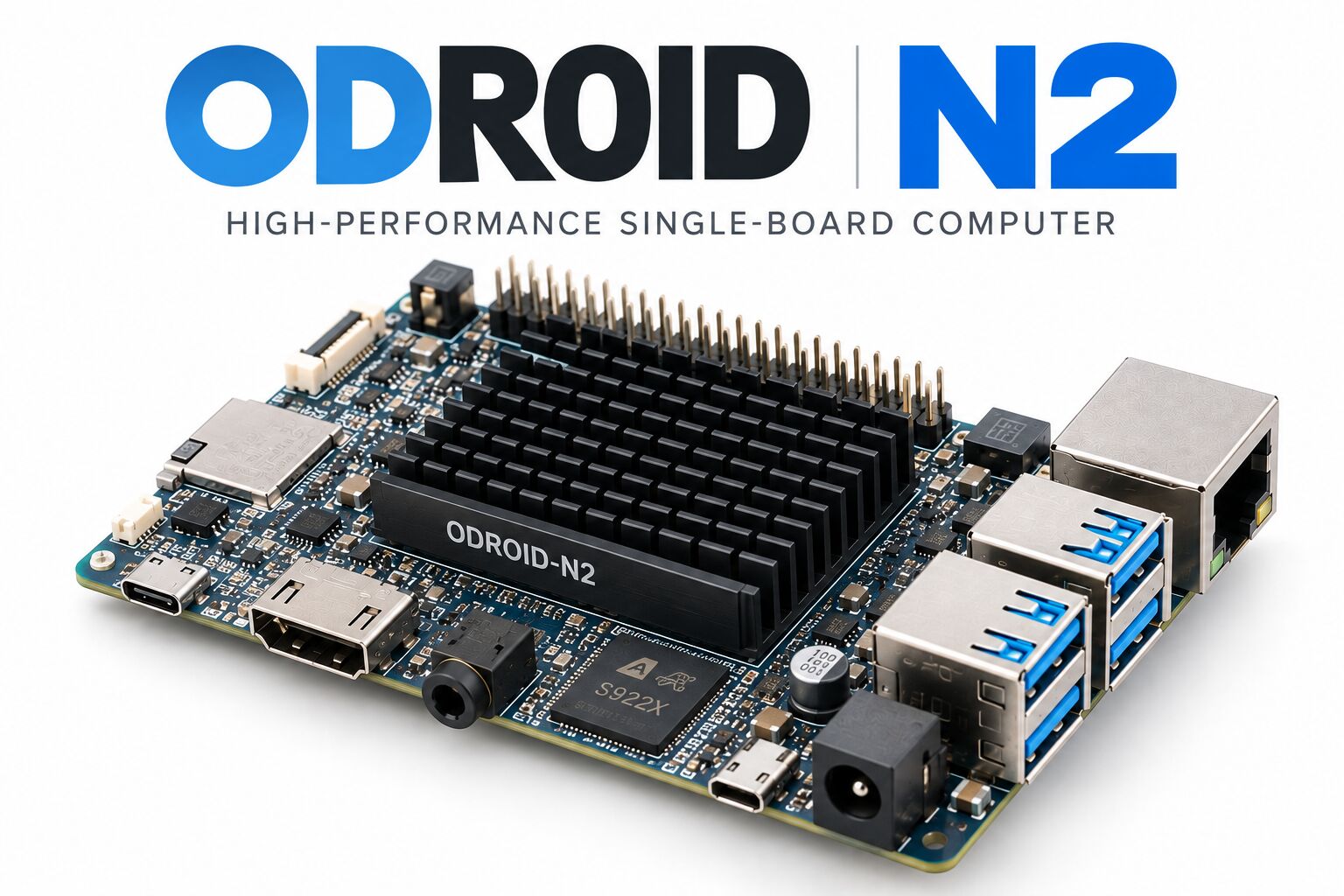
The ODROID-N2 is a high-performance ARM single-board computer developed by Hardkernel and built around the Amlogic S922X processor. It combines four ARM Cortex-A73 cores with two Cortex-A53 cores, a Mali-G52 GPU, DDR4 memory, Gigabit Ethernet, four USB 3.0 ports, HDMI 2.0, eMMC and microSD storage support, and a 40-pin GPIO header.
The ODROID-N2 was offered in 2GB and 4GB DDR4 configurations. Hardkernel has since discontinued the original ODROID-N2 and replaced it with the ODROID-N2+, so this page should be treated as a product reference rather than a current purchasing page.
ODROID-N2 Specifications
| Specification | ODROID-N2 |
|---|---|
| SoC | Amlogic S922X |
| CPU | 6-core ARM |
| CPU architecture | 4 × Cortex-A73 + 2 × Cortex-A53 |
| Cortex-A73 | Up to 1.8GHz |
| Cortex-A53 | Up to 1.9GHz |
| GPU | ARM Mali-G52 |
| GPU clock | Up to 846MHz |
| RAM | 2GB or 4GB DDR4 |
| Memory bus | 32-bit |
| Ethernet | Gigabit Ethernet |
| Ethernet controller | Realtek RTL8211F |
| Storage | eMMC, microSD |
| SPI Flash | 8MB |
| HDMI | HDMI 2.0 |
| Maximum display output | Up to 4K at 60Hz |
| USB | 4 × USB 3.0 + 1 × Micro USB 2.0 OTG |
| GPIO | 40-pin |
| Audio | 3.5mm stereo audio |
| Video | HDMI + composite |
| RTC | Yes |
| IR receiver | Yes |
| Cooling | Large passive heatsink |
| Power | DC input |
| Dimensions | Approximately 90 × 90mm board |
| Product status | Discontinued |
The specifications above are based primarily on Hardkernel’s original ODROID-N2 documentation.
Amlogic S922X Processor
The ODROID-N2 uses the Amlogic S922X, a 12nm ARM processor with a big.LITTLE configuration.
The processor contains:
- 4 × ARM Cortex-A73 cores
- 2 × ARM Cortex-A53 cores
- ARMv8-A architecture
- ARM Neon extensions
- Hardware cryptographic extensions
The Cortex-A73 cores provide the higher-performance processing capacity, while the Cortex-A53 cores are designed for lighter workloads.
Hardkernel originally specified the Cortex-A73 cores at up to 1.8GHz and the Cortex-A53 cores at up to 1.9GHz on the ODROID-N2.
This processor configuration makes the ODROID-N2 suitable for applications such as:
- Linux servers
- Home servers
- Media centers
- Development
- Docker
- Networking
- Retro gaming
- Embedded projects
Mali-G52 GPU
The S922X integrates an ARM Mali-G52 GPU.
On the ODROID-N2, the GPU can operate at up to approximately 846MHz according to Hardkernel’s original specifications.
The GPU provides hardware acceleration for supported graphics and multimedia applications.
Possible applications include:
- Linux desktop environments
- Media centers
- 3D applications
- Retro gaming
- Video playback
- Embedded graphics
Software support varies depending on the operating system and graphics stack being used.
2GB and 4GB DDR4 Memory
The ODROID-N2 was available with two memory configurations:
| Model | RAM |
|---|---|
| ODROID-N2 | 2GB DDR4 |
| ODROID-N2 | 4GB DDR4 |
The DDR4 memory operates at 1320MHz according to Hardkernel’s original product documentation.
The 4GB version provides additional memory for applications that need more RAM, including:
- Docker containers
- Web servers
- Databases
- Desktop applications
- Development environments
- Media applications
Gigabit Ethernet
The ODROID-N2 includes Gigabit Ethernet through an RJ45 port.
The Ethernet interface uses a Realtek RTL8211F Ethernet transceiver and supports:
- 10Mbps
- 100Mbps
- 1000Mbps
The Gigabit connection makes the board suitable for network-intensive applications such as:
- Home servers
- File servers
- NAS projects
- Media servers
- Docker hosts
- Network services
Hardkernel’s testing reported network throughput close to 1Gbps.
USB 3.0
The ODROID-N2 includes four USB 3.0 host ports.
These ports can connect peripherals such as:
- USB storage
- Keyboards
- Mice
- Game controllers
- Cameras
- USB adapters
- External hard drives
The four USB ports share a single USB root hub, so bandwidth can be shared when multiple USB devices are transferring data simultaneously.
Hardkernel measured approximately 340MB/s with a USB 3.0 UAS-capable SSD in its testing.
Micro USB 2.0 OTG
In addition to the four USB 3.0 host ports, the ODROID-N2 provides a Micro USB 2.0 OTG port.
The OTG interface can operate in host or device mode.
It can be useful for:
- USB device connections
- Development
- Debugging
- Embedded applications
The Micro USB port is not intended as the main power input.
eMMC Storage
The ODROID-N2 includes an eMMC module connector for removable eMMC storage.
Compatible eMMC modules were available in capacities including:
- 8GB
- 16GB
- 32GB
- 64GB
- 128GB
- 256GB
eMMC can provide faster storage performance than a typical microSD card and is suitable for operating-system installations and applications that require more consistent storage performance.
microSD Storage
The ODROID-N2 also includes a microSD card slot.
The board supports microSD cards up to UHS-I SDR104 modes.
A microSD card can be used for:
- Linux installations
- Testing operating systems
- Development
- Media-center software
- Recovery environments
Hardkernel’s testing reported sequential microSD performance exceeding 70MB/s read and 55MB/s write under suitable conditions.
8MB SPI Flash
The ODROID-N2 includes 8MB of onboard SPI flash.
The SPI memory can contain boot components including:
- Bootstrap binaries
- U-Boot
- A minimal Linux kernel
- Petitboot
Petitboot provides a boot-management interface that can allow the system to select the appropriate boot media.
This provides additional flexibility when booting from eMMC or microSD storage.
HDMI 2.0
The ODROID-N2 provides an HDMI 2.0 output supporting resolutions up to 4K at 60Hz, including HDR support.
The HDMI interface also supports:
- CEC
- EDID
This makes the ODROID-N2 suitable for:
- Media centers
- Linux desktops
- Digital signage
- Video playback
- Retro gaming systems
Composite Video
The ODROID-N2 includes composite video through its 3.5mm AV interface.
This can be useful with older displays and certain embedded or retro-gaming projects.
The same connector provides stereo analog audio output.
Audio
The ODROID-N2 includes an integrated high-quality stereo audio DAC.
Hardkernel specifies:
- Up to 384kHz sampling
- 32-bit audio
- Stereo output
- Approximately 100dB dynamic range
- Less than 0.006% THD
The board provides a 3.5mm stereo audio output and also supports digital audio through HDMI.
This makes the ODROID-N2 useful for:
- Media centers
- Music servers
- Audio projects
- Home theater systems
40-Pin GPIO Header
The ODROID-N2 provides a 40-pin GPIO expansion header.
The interface includes:
- GPIO
- SPI
- UART
- I²C
- ADC
The GPIO interface operates at 3.3V, while the ADC inputs have a maximum voltage of 1.8V.
The header can be used with:
- Sensors
- LEDs
- Displays
- Relays
- Buttons
- Robotics hardware
- Automation projects
The pin layout should be checked before connecting accessories designed for other SBC platforms.
Real-Time Clock
The ODROID-N2 includes an onboard RTC (real-time clock).
The RTC uses an NXP PCF8563 component and can be connected to a backup CR2032 battery.
The RTC can maintain the date and time while the main power supply is disconnected and can also be used for scheduled wake-up operations.
This is useful for:
- Servers
- Automation
- Embedded systems
- Scheduled operation
- Data logging
IR Receiver
An integrated infrared receiver allows the ODROID-N2 to receive signals from compatible infrared remote controls.
This is particularly useful for:
- Media centers
- Home theater systems
- Kodi
- Remote-controlled applications
Passive Cooling
The ODROID-N2 uses a large metal passive heatsink as part of its thermal design.
The processor is located on the underside of the PCB, allowing the heatsink structure to transfer heat away from the SoC and memory.
Hardkernel designed the heatsink to reduce thermal throttling during sustained workloads.
An optional active cooling fan connector is also available for applications that require additional cooling.
Power
The ODROID-N2 uses a DC barrel-jack power input.
The original specification supports an input range of approximately 7.5V to 18V, with Hardkernel recommending a 12V/2A power adapter.
Power consumption is relatively low for the hardware.
Hardkernel measured approximately:
- Idle: 1.6–1.8W
- Heavy CPU load: approximately 5.2–5.3W
These measurements were made under the testing conditions specified by Hardkernel.
ODROID-N2 Dimensions
The ODROID-N2 uses a square board design measuring approximately 90 × 90mm.
Its large metal heatsink increases the overall physical footprint and height compared with the bare PCB.
The combination of the board and passive heatsink was designed for stable operation without requiring a fan for typical workloads.
ODROID-N2 for Docker
The ODROID-N2 can be used as a compact ARM server for Docker workloads.
The 4GB version provides enough memory for a variety of lightweight and medium-sized container deployments.
Potential applications include:
- Web servers
- Reverse proxies
- Databases
- Home automation
- Monitoring
- DNS services
- File-sharing applications
- Self-hosted applications
The 4GB model is particularly useful when several containers need to run simultaneously.
ODROID-N2 as a Home Server
The combination of Gigabit Ethernet, USB 3.0, eMMC and microSD storage makes the ODROID-N2 suitable for home-server applications.
It can be used for:
- File servers
- Media servers
- Docker
- Web servers
- Home automation
- Network services
- Backup servers
External USB storage can be connected through the four USB 3.0 ports.
ODROID-N2 as a Media Center
The ODROID-N2’s HDMI 2.0 output, hardware video capabilities, audio DAC and IR receiver make it suitable for media-center applications.
The board has been used with software such as CoreELEC and Android-based media applications.
Potential applications include:
- Kodi
- Home theater
- 4K video playback
- Music playback
- Digital signage
- Retro gaming
ODROID-N2 for Retro Gaming
The combination of the S922X processor and Mali-G52 GPU gives the ODROID-N2 enough performance for a range of retro-gaming applications.
Possible uses include:
- Classic console emulation
- Arcade emulation
- Retro gaming distributions
- Android gaming
The actual emulator performance depends on the operating system, emulator and individual game.
ODROID-N2 for Development
The ODROID-N2 provides several interfaces for hardware and software development.
Developers can use:
- Linux
- Android
- GPIO
- SPI
- I²C
- UART
- ADC
- USB
- HDMI
This makes it useful for:
- Embedded development
- IoT projects
- Robotics
- Automation
- Linux development
- Hardware prototyping
Operating Systems
The original ODROID-N2 was supported by Linux distributions and Android.
Hardkernel provided Ubuntu images and an Android 9 Pie platform for the board. The original documentation references Ubuntu 18.04 LTS and Android 9, while community projects such as Armbian have also provided support for the ODROID-N2.
Because the original N2 is an older, discontinued board, users should verify the current software status before selecting it for a new project.
ODROID-N2 vs ODROID-N2+
The ODROID-N2 and ODROID-N2+ are closely related but are not identical.
The N2+ is a revision of the original N2 with higher CPU frequencies and other hardware changes. Hardkernel specifies up to 2.4GHz for the Cortex-A73 cores and up to 2.0GHz for the Cortex-A53 cores on the N2+.
| Feature | ODROID-N2 | ODROID-N2+ |
|---|---|---|
| SoC | Amlogic S922X | Amlogic S922X |
| Big cores | Cortex-A73 | Cortex-A73 |
| Small cores | Cortex-A53 | Cortex-A53 |
| A73 maximum | 1.8GHz | Up to 2.4GHz |
| A53 maximum | 1.9GHz | Up to 2.0GHz |
| RAM | 2GB / 4GB DDR4 | 2GB / 4GB DDR4 |
| GPU | Mali-G52 | Mali-G52 |
| Ethernet | Gigabit | Gigabit |
| USB | 4 × USB 3.0 | 4 × USB 3.0 |
| HDMI | HDMI 2.0 | HDMI 2.0 |
| GPIO | 40-pin | 40-pin |
| Storage | eMMC / microSD | eMMC / microSD |
| Status | Discontinued | Later revision |
The N2+ also introduced a built-in RTC backup battery holder and revised thermal design.
ODROID-N2 Product Status
The original ODROID-N2 is discontinued.
Hardkernel’s current product page identifies both the 2GB and 4GB ODROID-N2 models as obsolete and directs users toward the ODROID-N2+ 2GB and 4GB models instead.
This is important to include on the product page because users arriving through search engines may otherwise assume that the original N2 is still a current product.
The page can still be valuable as a reference for existing owners, used-board buyers and users researching the ODROID-N2 platform.
ODROID-N2 Product Summary
| Feature | Details |
|---|---|
| Product | ODROID-N2 |
| Manufacturer | Hardkernel |
| SoC | Amlogic S922X |
| CPU | 4 × Cortex-A73 + 2 × Cortex-A53 |
| GPU | Mali-G52 |
| RAM | 2GB / 4GB DDR4 |
| Ethernet | Gigabit |
| Storage | eMMC / microSD |
| SPI Flash | 8MB |
| HDMI | HDMI 2.0 |
| Maximum display | 4K@60Hz |
| USB | 4 × USB 3.0 + Micro USB 2.0 OTG |
| GPIO | 40-pin |
| Audio | 3.5mm stereo + HDMI |
| RTC | Yes |
| IR | Yes |
| Cooling | Passive heatsink |
| Power | DC barrel jack |
| Primary uses | Server, media center, development, retro gaming, embedded projects |
| Current status | Discontinued |
Frequently Asked Questions
What processor does the ODROID-N2 use?
The ODROID-N2 uses the Amlogic S922X, with four Cortex-A73 cores and two Cortex-A53 cores.
How much RAM does the ODROID-N2 have?
The original ODROID-N2 was available with 2GB or 4GB of DDR4 RAM.
Does the ODROID-N2 have Gigabit Ethernet?
Yes. It includes a Gigabit Ethernet port using a Realtek RTL8211F Ethernet transceiver.
Does the ODROID-N2 support NVMe?
The original ODROID-N2 does not have a dedicated onboard M.2 NVMe slot. Its primary onboard storage options are eMMC and microSD.
Does the ODROID-N2 have USB 3.0?
Yes. It has four USB 3.0 host ports.
Does the ODROID-N2 support 4K?
Yes. Its HDMI 2.0 output supports resolutions up to 4K at 60Hz.
Does the ODROID-N2 have Wi-Fi?
There is no integrated Wi-Fi on the original ODROID-N2. Wireless networking can be added using a compatible USB Wi-Fi adapter.
Does the ODROID-N2 have Bluetooth?
Bluetooth is not integrated into the original board. A compatible USB adapter can be used when Bluetooth connectivity is required.
Does the ODROID-N2 have GPIO?
Yes. It includes a 40-pin GPIO header supporting interfaces including GPIO, SPI, UART, I²C and ADC.
Can the ODROID-N2 run Docker?
Yes. The ARM64 platform can be used for Docker workloads, provided compatible ARM images are available.
Is the ODROID-N2 still available?
No. Hardkernel lists the original ODROID-N2 as discontinued/obsolete and recommends the ODROID-N2+ as its successor.
What replaced the ODROID-N2?
The ODROID-N2+ is the direct revision of the original ODROID-N2. It retains the S922X platform while increasing the maximum CPU frequencies and making several hardware changes.